

From CBS Sunday Morning
The Year of Living Constitutionally: One Man's Humble Quest to Follow the Constitution's Original Meaning. A. J. Jacobs. Crown, 2024. 304 pages.
I saw a story about this book on "CBS Sunday Morning" a few weeks ago and thought it sounded interesting. I regretted my purchase before I was finished with the author's introduction. Strike one: the author decided to illustrate the second amendment by walking around New York City carrying a musket and bayonet everywhere. Nobody did that in 1787. Reeks of narcissistic, agenda-driven stunt. Strike two: Maybe it was meant to be a joke, but he wrote that his children invoke the first amendment every time they call him names. Even joking about that (calling a parent names) is unfathomable to me. If it's a joke, not funny; if not, it's so far removed from my experience to make it too weird. (Yes, I am very old-fashioned in some ways.) Strike three: In a couple of paragraphs, he goes on and on about what he describes as the shockingly brutal and horrific language used in the Constitution. If you're triggered by words in an historic document, maybe you should stay away from history. I bailed on this book in the first chapter, not worth my time.

Author talk
Palace Council. Stephen L. Carter. Knopf, 2008. 528 pages.
"In the summer of 1952, twenty prominent men gather at a secret meeting on Martha’s Vineyard and devise a plot to manipulate the President of the United States. Soon after, the body of one of these men is found by Eddie Wesley, Harlem’s rising literary star. When Eddie’s younger sister mysteriously disappears, Eddie and the woman he loves, Aurelia Treene, are pulled into what becomes a twenty-year search for the truth. As Eddie and Aurelia uncover layer upon layer of intrigue, their odyssey takes them from the wealthy drawing rooms of New York through the shady corners of radical politics, all the way to the Oval Office." Publisher's blurb
This is, I think, the third book by Stephen L. Carter that I've read, following Invisible, his great biography of his grandmother, and another political thriller, the genre of most of his writing. This book is definitely a complex and suspenseful thriller that takes the reader into the world of the black upper class of Harlem and the political back rooms of Washington DC from the Brown vs Board of Education decision to Watergate. Eddie Wesley, a rising literary figure, stumbles into a complex web of political intrigue that can, and does, become a major disruption of his life and a threat to the country. It's an excellent read.

Author Talk
Painter in a Savage Land: The Strange Saga of the First European Artist in North America. Miles Harvey. Random House, 2008. 368 pages.
In 1564, a group of French Huguenot (Protestant) colonizers landed in northern Florida and established a settlement named Fort Caroline on the St. John's River, near modern day Jacksonville, but the exact site is still unknown today. In 1565, the Spanish founded St. Augustine and immediately set out to destroy their rival's toehold in the New World, mutilating and massacring most of the French, who were not only enemies of Spain but also Protestant heretics, so they massacred and mutilated in the name of God, forcing the French to set their sights north - Canada. One of the few French survivors was Jacques Le Moyne de Morgues, the official artist and cartographer of the expedition, the first European artist to set foot in the continental United States and a very mysterious and significant figure in history. The mystery? Very little is known about his life before and after Fort Caroline. Then, there's his American work itself. To date, historians have discovered none, or almost none, of his original illustrations of the Native Americans in the area, illustrations of the French colonizers and the fort, and maps that he drew. The works attributed to Le Moyne are actually reproductions of his works made by contemporaries John White (the governor of the failed Roanoke colony) and Theodor de Bry and many others, each of whom applied his own vision and agenda to Le Moyne's work. The result is that historians have questioned the authenticity and reliability of the images. The Indians often have European features, and they are shown using tools and weapons that the Florida Indians would have never seen. Many of the images are incredibly violent and brutal depictions of war, sacrifice, and even cannibalism. Le Moyne's original captions and labels have been lost or altered over time. Did Le Moyne even witness these events? Are the misrepresentations accidental or intentional? For what purpose and who did the misrepresenting, Le Moyne or White or de Bry?
Even Le Moyne's work after Fort Caroline is mysterious. He seems to have spent most of the rest of his life doing incredibly beautiful and accurate botanical paintings, but most of those works known to us today were only discovered in the 20th century. Harvey explores these mysteries and the history of Fort Caroline in this fascinating book.

Audiobook preview
Paperbacks From Hell: The Twisted History of '70s and '80s Horror Fiction. Grady Hendrix. Quirk Books, 2017. 256 pages.
I'm not a huge fan of the horror genre, but I am well aware of the author Grady Hendrix, a huge star in the field. Hendrix possesses a love and knowledge of the horror genre that is unmatched, a human encyclopedia on the subject. His novels each tackle a different sub-genre, like vampires or zombies or haunted houses, include all the best (and worst) elements of the sub-genre, and are simultaneously frightening and hilarious. In 2017, he published this history of horror literature of the 1970s and 1980s, a golden age of horror novels, movies, and television.
I've always been a fan of shlock. I love 1950s B-movie monster and sci-fi movies, I grew up on "Dark Shadows" reruns after school, I won't pass up a 70s demon cult movie when I'm TV grazing, and I have been known to read a really trashy novel here and there, so this history is right up my alley. My "to view" and "to read" list has grown as a result. It's a relatively short book, but it is so full of details and information about dozens and dozens of works and authors and about how those works reflected the events of the day. (There is much to be learned by historians studying popular culture and entertainment.) Hendrix's humor is a super bonus, funny lines zooming left and right, like when he describes a particular group of books as "Scooby Doo, but with more orgies." Never in my life would I have dreamed that there were so many books featuring prehensile penises and nipples, man-eating (literally) vaginas, exploding babies, satanic cults, and cannibalism and much, much more. This was a really fun read, and I think that I will read some of his novels. (And I may be spending more time in the horror sections of my favorite used book stores.)

Ken Burns interview Erik Larson on Demon of Unrest
CBS Sunday Morning
The Demon of Unrest: A Saga of Hubris, Heartbreak, and Heroism at the Dawn of the Civil War. Erik Larson. Crown, 2024. 592 pages.
You can't go wrong with an Erik Larson book. Well, except for his last book, in my opinion, an attempt at horror fiction that made my worst books of the year list. No worries, though, he is definitely back on track with Demon, which may now be at the top of my list of favorite Larson books. I don't think it matters much how much you know about the Civil War and the events leading up to the firing on Fort Sumter; you will learn much more from reading this book. Larson is the undisputed king of narrative nonfiction, and like his previous books, this book reads like a thriller. The subtitle is incredibly apt in this case, as the story is crammed full of "Hubris, Heartbreak, and Heroism." Larson does a great job of establishing why South Carolina started the whole thing, with his explanation of the mindset of "the Chivalry," the uniquely South Carolinian mindset among its planters that simultaneously crippled progress and filled them with wild romantic fantasy, leading to the conflict. He uses two great allusions, comparing South Carolina to Miss Havisham in Great Expectations, the jilted bride for whom time stops, and paralleling the events leading up to the firing to the Code Duello, the Dueling Code which was at the center of a southern gentleman's honor, and thus, his being.
Larson incorporates the stories and personalities of the people involved in the events so well through diaries, letters, and documents. Of course, there are insights into Lincoln, Davis, Confederate General P.G.T. Beauregard, and Sumter commander Major Robert Anderson, but the reader also gets to know some lesser known characters like James Hammond, slavery apologist and stoker of South Carolina's ardor for conflict, Edmund Ruffin, the pied piper of secession who traveled the South urging secession, Captain Abner Doubleday, US officer at Sumter who seldom saw eye to eye with Major Anderson (and who definitely did not invent baseball), and Mary Chesnut, wife of a prominent planter whose diary is a phenomenal record of the times. There's also Lincoln's chief political rival and Secretary of State William Seward along with several other US and Confederate Cabinet heads and other government officials who each seemed to have their own agenda. This book is a must read!

Authors talk
Ella and Marilyn, the "Drunk History" version
Can't We Be Friends: A Novel of Ella Fitzgerald and Marilyn Monroe. Eliza Knight and Denny S. Bryce. William Morrow Paperbacks, 2024. 384 pages.
Thanks to the internet, people are becoming more and more aware of an extraordinary friendship between two of the most famous women of the late 1950s and early 1960s, Marilyn Monroe and Ella Fitzgerald, legends in their fields, at the peak of their careers. I've never been a jazz fan, and I've never sat down and listened to Fitzgerald. To me she was just that lady who popped up on 1970s variety shows and broke the glass with her voice in a commercial in the 1980s, but I recognized her great talent. I've seen some of Monroe's movies and thought they were interesting, but I know much more about her personal life because of the "scandals" and conspiracies. Historical fiction authors Denny Bryce and Eliza Knight have written a very entertaining novel about the deep friendship that emerged from letters that Monroe wrote to Fitzgerald asking for voice lessons. Their common bond, besides real mutual admiration for each other's talents, was struggle. For Fitzgerald, the external struggles were against racism, sexism, and body-shaming, while she struggled internally with finding true love and doubting her mothering because she left her son to be raised by an aunt while she toured the world. For Monroe, there was the sexism of Hollywood which not only affected her earning power and personal control over her career, but it also led to type-casting and unfair accusations of unprofessional behavior. Then, there was her horrible track record with men, which was both a cause and a symptom of her mental instability, depression, and self-doubt that led to major alcohol and pills addiction.
The book is not a biography, but the authors obviously did a great deal of research, and they created an enlightening and entertaining novel which has added to my understanding of and appreciation for both women. (By the way, much of the recent internet storytelling gets it wrong, apparently. Yes, Marilyn may have helped Ella get bookings in certain L.A. clubs, but Ella wasn't ignored by those clubs because she was black. Black women like Dorothy Dandridge, Earth Kitt, and Lena Horne performed in those clubs frequently. Ella was ignored because she had a fuller figure than those women.)
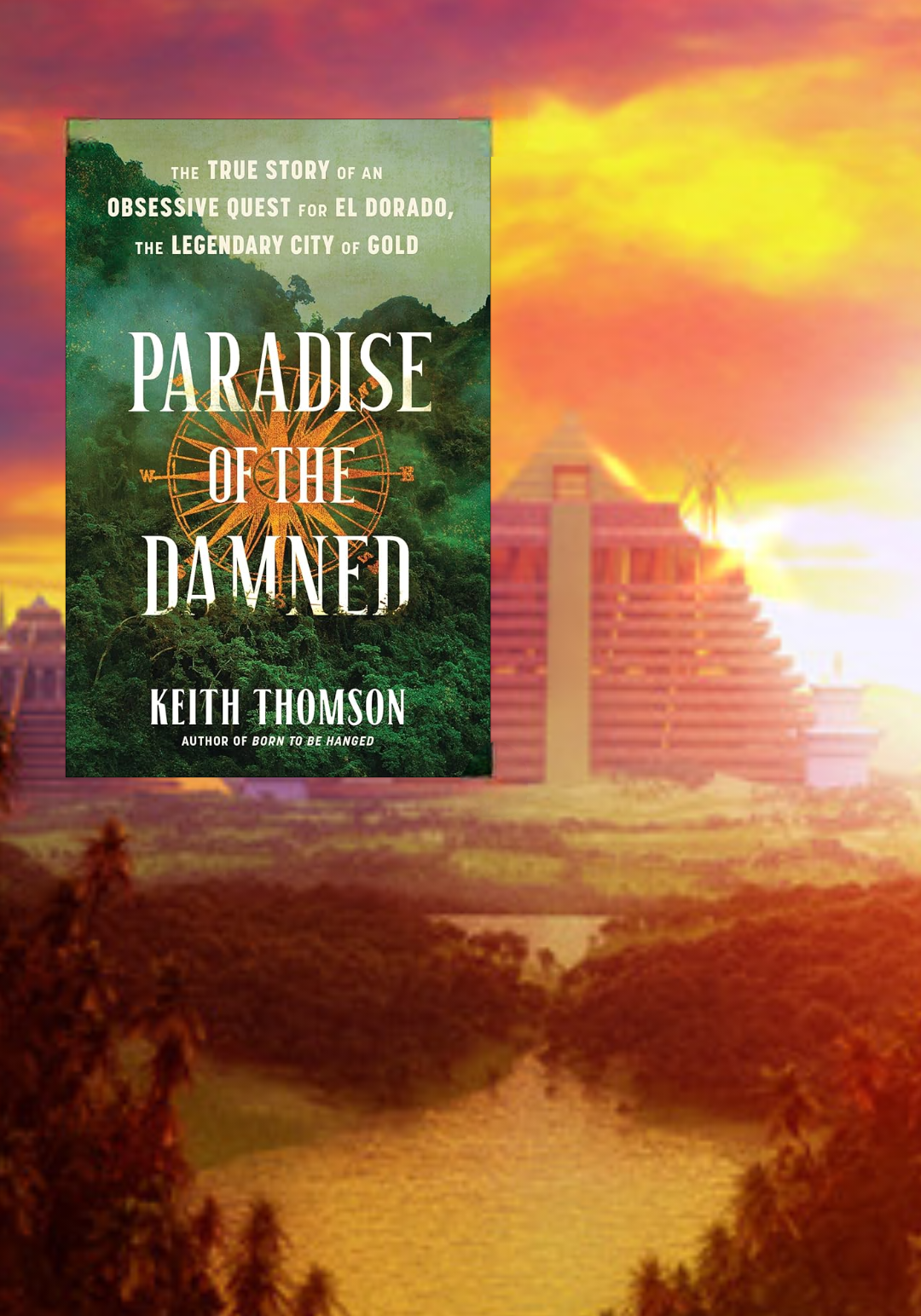
Paradise of the Damned: The True Story of an Obsessive Quest for El Dorado, the Legendary City of Gold. Keith Thomson. Little, Brown, and Company, 2024. 400 pages.
Keith Thomson, the author of the excellent history of pirates Born to Be Hanged, just published Paradise in May. It's the story of the mythical land of El Dorado, the city of gold described by indigenous tribes and sought after by European for centuries, but this book approaches the story from a different angle than the books you've read and documentaries you've seen, focusing not on the Spanish search for the fabled city but on the English efforts instead. Not just the English efforts in general, but the efforts of one of the most interesting Englishmen in history in particular, Sir Walter Raleigh. Raleigh was a soldier, explorer, writer, poet, and colonizer made famous in English history and legend, for his battles against the Spanish, failed colonial attempts at Roanoke, and introduction of tobacco and potatoes to England. He's also famous as a long-time favorite of Queen Elizabeth I and a victim of her successor, King James I. However, he became an ardent believer in the Spanish stories of El Dorado and spent years of his life and much of his personal fortune exploring South America in search of the city that would grant huge personal riches on himself and on the queen he loved. He and his men endured incredible hardships slogging through jungles and battling the Spanish on numerous expeditions, while his many enemies at court used intrigue and manipulation at home to push him out of Elizabeth's fickle favor, and, in the end, to get him imprisoned in the Tower of London and executed. Thomson's book is a great review of his life, the endless political jockeying within the English court, and the impossible quest of so many Spanish and English explorers.


