Showing posts with label #crimefiction. Show all posts

Saturday, January 31, 2026

Shelved: Books Read and Reviewed in January 2026


Stranger in a Strange Land: The Controversy

Stranger in a Strange Land.  Robert A. Heinlein.  G.P. Putnam's Sons, 1961.  408 pages. 

My first finished book of 2026 is a classic.  Published in 1961,  Stranger in a Strange Land  is an iconic science fiction novel that has had a huge influence on modern culture and has been a subject of controversy ever since its publication.  It was awarded the Hugo Prize for best science fiction novel in 1962, it became the first the first sci-fi novel to enter the New York Times Book Review's best seller list, and it has been included as a "Book That Shaped America" by the Library of Congress.  I'm pretty sure my ninth grade English teacher recommended it, and I was a huge sci-fi reader throughout high school, but I'm not sure if I read it then.  It's one of the oldest stories known to man:  the fish out of water, a strange innocent who is thrust into a wicked world, observes the foibles and follies of humanity, is changed by humanity, acquires followers and admirers, and is then destroyed by the world, leaving the possibility of a better world in his wake.  The story's been told a million times, including in the New Testament.  In this case, the Christ figure is Valentine Michael Smith, a human survivor of a Mars expedition as a baby that was raised by the Martians and returned to Earth as a spy, but  a spy with tremendous powers of the mind including telepathy, telekinesis, and teleportation, just to name a few.  After his tutelage under a surrogate father figure, Valentine begins his transformation into a kind of messiah. His exceptional abilities lead him to become many things to many people: freak, scam artist, media commodity, searcher, free love pioneer, neon evangelist, and martyr. Controversy? First, there were objections to the perceived attacks on religion in general and Christianity in particular.  Second, it was one of the first mainstream sci-fi novels to include sex, and not just sex, but lots of nudity and free love,  Finally, there were rumors that the book was a huge influence on Charles Manson and his murderous Family, and these rumors led to the book being removed from libraries across the country.  (Although Manson did make himself into a messiah who demanded free love and group sex for his followers, it is unlikely that he ever read the book since he was functionally illiterate.  However, it is quite probable that some of his better-educated followers had read it, and they used the word "grok" - a word created by Heinlein  for the book to mean a thorough and complete understanding or grasping of a concept.  More recently, Elon Musk decided to name his artificial intelligence app "Grok" - for whatever reasons.)  Some sixty years later, the book is controversial for another reason:  sexism, based on its portrayal of women and relationships.  Sure, but I would argue that you have to look at the time it was published.  Second wave feminism was just blossoming with Betty Friedan and Gloria Steinem still unknown. The sexual revolution was just underway with sexologists like Kinsey, Masters, and Johnson becoming public figures, Hugh Hefner was attempting to create a Playboy world, and the birth control pill was first used in 1960. Sex was emerging into public discourse like never before.   Actually, I think the portrayal of women and sex in the book is very progressive for the time, and, in many ways, women enjoy a state of equality in Heinlein's world that did not exist in 1961 America.  The book is a deeply insightful and thought provoking take on America and American institutions.  


Double Whammy.  Carl Hiaasen.  Putnam, 1988.  320 pages.  Book 1 of 7 in Skink series.

If there was a Mount Rushmore of writers of the "Florida Man" genre of fiction, the faces would be those of Tim Dorsey, Carl Hiaasen, Dave Berry, and Randy Wayne White, authors who excel at creating incredibly ridiculous and exciting stories about heroic, but flawed, Floridians and the assorted crazies that complicate their lives and threaten their friends.  Their stories are all based in and inspired by real events and real history that can only have happened in the Sunshine State, and then they add their own brand of twisted elaboration that makes the genre so unique.  This Hiaasen novel is the first to recount the adventures of private detective R.J. Decker and his partner Skink, a 6' 6 " tall bearded misanthropic hermit who lives in the Florida Everglades and subsists on a diet of roadkill.  While Skink is a legendary character in his neck of the woods, almost no one knows that Skink was actually once the Governor of Florida, Clinton Tyree, the most honest man ever to be governor of any state, so honest, in fact, that he couldn't take the pressure of politics, snapped, and ran away from office to become a crusading environmentalist, carrying on a one-man fight against evil developers.  Skink and Decker find themselves entangled in the dangerous, high-money-stakes, life or death world of professional bass fishing.  A major cheating scandal turns deadly, and bodies pile up/  Oh, and there's a murderer who talks to the dead head of a pet bull that is clamped to his right arm.  Insanity.  Or just another Florida Man story.


Caravaggio Documentary

Caravaggio:  A Life Sacred and Profane.  Andrew Graham-Dixon.  W.W. Norton & Company, 2012.  544 pages.

Inspired by a great exhibition focusing on Caravaggio and baroque art at St. Petersburg's (Florida) Museum of Fine Arts, I purchased this biography and found it to be a truly great one.  Michelangelo Merisi da Caravaggio, usually known simply as Caravaggio, was, and is, the greatest artist of the baroque, and his influence continues to resonate throughout the artistic world.  Filmmaker Martin Scorsese recognizes often describes the huge influence Caravaggio is on his own films with the look, the stories, and the characters very visibly reflecting elements of the painter's life and world. Caravaggio pioneered the use of light and dark as key elements in his work, and his paintings are full of life, action, and vibrancy. The paintings all tell vivid stories.  Since his patrons were often Catholic Church officials who sought to use the power of art as propaganda, designed to win the hearts and devotion of the people who might otherwise be tempted by the Protestant Reformation, he often painted gritty, often bloody, scenes of Old Testament battles and violence and of the horrific martyrdoms of saints murdered for spreading the gospels of the New Testament, often shocking his patrons and other viewers with their graphic brutality.  His personal life was equally profane.  He was either homosexual or bisexual at a time when that was punishable by death.  He was known for engaging in drunken, violent brawls, roaming the city with like-minded young troublemakers, and associating with prostitutes and pimps.  Sentenced to banishment and death for killing a rival in a duel, he was forced to live a life on the run, before he himself died, under mysterious circumstances, at a very early age.  He still managed to create a revolutionary body of work.  This bio covers his life and his works thoroughly and is equally as masterful as his work.  


White Shadow.  Ace Atkins.  Putnam, 2006. 384 pages.

This is the second work of historical fiction based on a real-life crime written by Ace Atkins that I've read.  Devil's Garden was about Roscoe "Fatty" Arbuckle's trial for the death of a would-be actress in 1921.  White Shadow is about the 1955 murder of Tampa Florida organized crime boss Charlie Wall.  Living in Tampa Bay, this  book is of particular interest because of the connections to history and locations in Ybor City in particular and the area in general.  I've read several books, attended talks, and taken tours on the subject of the organized crime that dominated much of Tampa's 20th century history, so a lot of this book is very familiar, and it's always fun to make historical connections as I travel around the city.  Having read two Atkins books, I've drawn some conclusions.  In Ace Atkins' world, the 1920s and the 1950s were very similar, whether the location was San Francisco or Tampa.  Everybody was always depressed, angry, miserable, and morally ambiguous.  Everybody had lots of really bad and unpleasurable sex with lots of different people, and that sex usually involved tears, violence, and lots and lots of alcohol and/or drugs.  Love doesn't exist, but drugs, alcohol, guns, gambling, prostitution, and many other vices were openly available everywhere.  Everybody talked like Rocky and Mugsy, the gangsters in the Bugs Bunny cartoons, all of the time (In Tampa, though, it was with a Cuban or Italian accent.). I know Atkins is a huge admirer of the detective noir genre and especially Dashiell Hammett, but it's just soooo much for sooooo long -  the books go on and on and on, far too long.  I really want to like his books more than I do.  His most recent book, a Cold War spy thriller, is set in Atlanta in the 1980s.  I haven't decided if I'm up for reading what Atkins does to make that setting depressing for me.  


Author talk

King of Kings:  The Iranian Revolution:  A Story of Hubris, Delusion, and Catastrophic Miscalculation.  Scott Anderson.  Doubleday, 2025. 512 pages.

The Iranian Revolution and the resulting American hostage crisis happened exactly because of the reasons cited in this book's title:  hubris, delusion, and miscalculation. Add stupidity, incompetence, impotence, and entrenched bureaucratic insanity.  Shah Mohammad Reza Pahlavi  was one of the most ill-suited men ever to be called "King of Kings."  He was not that bright and had led a totally isolated and exalted life from his birth that separated him from reality.  He had almost no competent advisors that ever dared to tell him the truth.  Negative reports and statistics were routinely changed to positive ones before they were presented to him.  He was incapable of making decisions, especially under duress.  Instead, he relied on others to take action and, consequently, to take the blame if the action failed.  Jimmy Carter was an inept, incompetent boob, totally in over his head from the second he stepped into the White House.  Like the Shah, he was far too involved in petty details, didn't have competent and honest advisors, but he was further handicapped by his outsider status that made him the subject of ridicule, mistrust, and derision by the Washington bureaucrats and professional politician class who actively kept information from him and had no interest in carrying out his policies.  Neither man saw the world as it was.  Ayatollah Ruhollah Khomeini was a provincial hard-line religious zealot who had no idea about or interest in how a country should be run.  His small group of advisors rallied around him simply because he was a viable alternative for the people's support and ignored his brutal medieval core philosophy.  A coalition of wildly disparate factions including socialists, communists, modernists, republicans, and religious fundamentalists came together, only united by their desire to depose the Shah, and they each thought Khomeini could be used to attain their goal and then discarded, but almost none of them had any real confidence that a revolution would be successful.  The CIA was totally incompetent (as usual), reporting to the White House, even days before the revolution, that the Shah was secure in his position for decades to come.  The US Ambassador to Iran was an idiot, and embassy and consulate officials in Iran were not Iranian experts and couldn't even speak the language, just marking time until their next ill-fitted posting.  They routinely ignored and buried the reports and observations of the one staffer who saw what was happening well before it did, and he was threatened with dismissal and frozen out of any meaningful role within the staff.  Scott Anderson does a fantastic job of explaining what happened and why in this book, and it is incredibly readable.  This is the book to read if you want to know about modern Iranian history and the history of the revolution, the effects of which still resonate almost 50 years later. 


Author Talk


Recipes From the American South.  Michael Twitty.  Phaidon Press, 2025.  432 pages.

This book is a must-have addition to any cookbook or southern history or southern food library.  It's the southern version of Julia Child's Mastering the Art of French Cooking in terms of scope and importance.  Michael Twitty has become one of America's greatest culinary historians.  He started out as a re-enactor, researching and demonstrating the foods and foodways of the American South that resulted from the blending of West African, Caribbean, Native American, and European cultures that resulted from the African diaspora and slavery.  His work illustrates both the importance of food history and the power of food to cross boundaries, erase differences, and unite people.  However, the region is vast, and even southern food is not monolithic.  Twitty presents 260 recipes that cover the entire breadth of southern cuisine.  The recipes are tested and prove, the photos are beautiful, and there are short histories of each dish.  Cooks will discover familiar recipes for dishes that their families have made for generations, but they will also discover new recipes and learn things about the old and the new in the process.  I've made some of the recipes and I will be making more, and the book has already become a first reference for me.  It is definitely a classic that should be on any southern cook's shelf.


The Buffalo Hunter Hunter.  Stephen Graham Jones.  S & S/Saga Press, 2025.  448 pages.

Stephen Graham Jones is apparently a very successful writer of western horror fiction, lauded by authors like Stephen King and Tommy Orange and often compared to Cormac McCarthy, but I had never heard of him until his newest book appeared everywhere, including on practically every "Best of 2025" list that I saw.  A diary written by a Lutheran minister in Montana in 1912 is discovered and examined by an academic who happens to be his direct descendant.  The minister recounts stories told to him by a Blackfoot Indian named Good Stab, stories of a flesh-eating, blood-sucking supernatural vampire roaming the plains out for revenge.  What's not to like, right?  It's my first Did Not Finish of the year, after about a fifth of the way through.  It is - incredibly - mind numbingly BORING.  First of all, it's a story within a story within a story, so there is a huge gulf between the reader and the "action."  Secondly, the language is stilted and tedious.  The creature doesn't just attack and eat animals, it eats "big mouths," "little mouths," "prairie runners," "whitehorns," "blackhorns," "long legs," "dirty faces," "moving shadows," and "wags-his-tails."  What? What's that? Huh?  Finally, its pace is not slow; it's plodding and ponderous, a real slog.  Multiple times, I realized that the creature was eating, and I thought "Wait, what happened?"  I see references in reviews and summaries to extreme violence and gore and found myself in the middle or at the end of such scenes without knowing how I got there.  This is a terrible book.  


Scene from "The Reivers" 1969

The Reivers.  William Faulkner.  Random House, 1962.  320 pages.

The other day, I noticed Turner Classic Movies was airing 1969's "The Reivers" starring Steve McQueen, and I tuned in for a few minutes.  I decided to make the book my second classic read of the year.  Published by William Faulkner in 1962, it was awarded the Pulitzer Prize in 1963, making Faulkner only the fourth author to win two Pulitzers.  I've read a few Faulkner classics, and admire his work, but The Reivers  is different.  Perhaps Faulkner's most accessible book, it's a comedy, a picaresque novel, that is an adventure story in which a naive or roguish, or both, hero goes on an adventure, encountering unusual characters and real world issues and corruption along the way.  In this case, it's 11-year old Lucius Priest, a resident of  Faulkner's Yokanaptawpha County Mississippi, who unwittingly gets dragged into Boon Hogganbeck's crazy scheme.  Boon works for Lucius' grandfather, but one day he decides to steal or borrow the grandfather's car, one of the only cars in town at the time, and go to Memphis.  A few miles out of town, they discover that Ned McCaslin, a black man and fellow employee of the grandfather and an actual blood relative of Lucius, had stowed away in the car.  Together, they head off to Memphis, landing at a brothel run by Miss Reba, and Boon gets reacquainted with his favorite girl, Miss Corrie.  Long story short, Ned trades the car for a race horse, and they plan to run a race in order to win the car back.  Hijinks ensue.  It's not a bad story and a very different side of Faulkner.  Probably 3 or 3.5 out of 5 for me, mainly because I 'm not really a fan of  horse racing.


CBS Sunday Morning segment

The Barn: The Secret History of a Murder in Mississippi.  Wright Thompson.  Penguin Press, 2024.  448 pages.  

Place.  It is one of the most vital elements of the study of history.  It acts as a physical, emotional, and cognitive anchor, a three-dimensional primary document that transforms abstract events from the distant past into tangible, relatable experiences, providing invaluable context to the events that happened upon it and to the lives of the people who lived there, worked there, fought there, loved there, and died there. "Place" provides a connection that is not possible otherwise.  Think about the feeling you have on a battlefield or in a home or site, when your senses take it all in and  often both a new understanding and a new curiosity arise.   I've read very few books in my life that capture place as well as this book does.  Wright Thompson has mastered the craft and can teach lessons on the subject.  I've had this book ever since it was released, but I've only read it in the past few days.  After all, I knew the story of Emmett Till, I taught the story of Emmett Till every year, and  I knew it would be a tough read emotionally.  And it definitely is. It makes you despair and lose all hope for humanity (if you had any at the start).  If you know it, it makes you hear Nina Simone's song "Mississippi G*****n" on a constant loop in your head, and makes you believe that the world and country would be much better off if Mississippi had never existed, or at least hadn't been settled by any new humans after 1600, that Mississippi is hell on earth, populated by the moat deranged and depraved "people" in history.  (And when a native Georgian now living in Florida  says that, that's saying something.)  It is not all depravity, however.  The reader is introduced to some truly brave and heroic people that are usually not a part of the story:  friends and relatives of Emmett and his mother, witnesses who were previously ignored by the law and by the media, and people who have devoted their lives to keeping the story alive in the 7 decades since. This is not only a new history of the kidnapping and murder of a 15-year old boy and the intense and coordinated effort throughout the state over the ensuing decades to erase it from history and from the minds of white and black Mississippians, but it is also a history of Mississippi, the place, going back to before European contact and encompassing every aspect of its history.  The barn in which Till was tortured, mutilated, and murdered is like an epicenter of that history.  The Delta Blues were born, King Cotton thrived and collapsed, Indian villages were decimated, and the Archie Manning football dynasty was born, all within a few miles of the nondescript farm shed.  All of that comes to life in this book.  This book should be the required textbook for Mississippi state history classes. It should be required reading for all Americans.  


Monday, March 31, 2025

Shelved: Books Read, Reviewed, and Shelved in March 2025


Gator A-Go-Go.  Tim Dorsey.  William Morrow, 2010.  352 pages.  #12 of 26 in Serge Storms series.

"It's history. How can you not be fascinated?"  Serge Storms.

Serge Storms is my fictional alter ego.  OK, maybe not the psychotic, serial killing vigilante part, speeding across Florida and punishing criminals and the ill-mannered and annoying on behalf of the victimized - not yet anyway - but the super-enthusiastic love and knowledge of all things related to Florida's human and natural history.  Serge makes me look like a piker in comparison.

In this adventure, Serge relates the history of spring break in Florida to the reader, to his faithful companion Coleman, and to anybody who finds himself within the general vicinity.  As usual, the thrilling story involves multiple parties, all in pursuit of something.  In this case, a murderous Miami drug gang led by "Madre" Juanita, FBI agents overseeing the Witness Protection Program, and the producers of a "Girls Gone Wild"-style video series, not to mention lots of innocent spring breakers.  Characters from previous Serge adventures appear and get involved as well.  As always, it is a very fun ride.  I love this line from the Raleigh News & Observer’s review and “gobble up the Serge A. Storms stories…and you’ll see what an overrated, humorless dullard Hannibal Lecter has always been.


Author talk

Kugels and Collards:  Stories of Food, Family, and Tradition in Jewish South Carolina.  Rachel Gordin Barnett and Lyssa Kligman Harvey.  University of South Carolina Press, 2023.  256 pages.

South Carolina became home to some of the first Jews to ever live in North America, with the first recorded Jewish settlers arriving in Charleston in the 1690s.  Over the centuries, more Jews arrived, both Sephardic and Ashkenazi, then Germans, Russians, and Eastern Europeans, at the turn of the 20th century and, later, escaping the Holocaust.  Jewish families adapted and blended their traditions and foodways in their new home, influenced by contact with other ethnic groups, black and white, and by new and different ingredients that they found.  The result is this history and cookbook, containing some 80 recipes alongside dozens of stories about their creation and history.  As I've said lots of times in the past, it's hard to go wrong when combining food and history, and this book is a revealing insight into a particular culture.


Author Talk

Paper Bullets:  Two Artists Who Risked Their Lives to Defy the Nazis.  Jeffrey H. Jackson.  Algonquin Books, 2020. 336 pages.  

Another book about anti-German resistance in occupied territory during WWII, but this one is unique.  First, it's set on the island of Jersey, one of the Channel islands between France and the UK which doesn't get a lot of ink.  Second, it's the first book to tell the story of two queer artists, Lucy Schwob and Suzanne Malherbe (known in the art world as Claude Cahun and Marcel Moore), whose lives and resistance were almost forgotten.  Third, their resistance involved no weapons, no espionage, and no hiding of Jews or Allied pilots.  Their resistance was writing anonymous notes.  That might sound benign and low-key, but their actions were still punishable by death.

Schwob and Malherbe were well-to-do French women (childhood friends who actually became stepsisters when their parents married) who became lovers and were deeply involved in the cross-dressing, homosexual, gender-bending, artistic, and literary free-for-all that was Paris in the 1920s.  They socialized with all the big names (Gertrude Stein, Andre Breton, Salvador Dali, Aldous Huxley, among others) of the Lost Generation and Surrealism.  They became avant-garde artists themselves, dabbling in various media but mostly photography focusing mostly on gender and challenging social norms. As the European situation deteriorated, they decided to move to the quaint peaceful island of Jersey.  There, they had to closet themselves as just sisters because it was a different world from Paris.  Their respite was brief, however, as Jersey was occupied by German troops.  The pair began a propaganda war against the occupiers, conducting psychological warfare by creating and distributing "paper bullets" — small typed notes containing wicked insults against Hitler, calls to rebel, and subversive fictional dialogues designed to demoralize Nazi troops.  They would sneak the notes into soldiers pockets, on and in vehicles, and various other places.  Finally arrested and sentenced to death, they continued resistance in prison, reaching out to other prisoners to lift their spirits.  It's quite an interesting story.


The Clockwork Universe:  Isaac Newton, the Royal Society, and the Birth of the Modern World.  Edward Dolnick.  Harper, 2011.  400 pages.

England's 17th century was chaotic - a civil war, the execution of a divinely appointed king, a religious dictatorship, religious wars and persecution, a plague, the Great Fire of London, and a relatively bloodless royal coup.  London's streets were covered in filth, the overwhelming majority had no access to clean water or education, and the murder rate was five times higher than today.  At the same time, England's fortunes as a trading power and colonizer were rising, coffee houses boomed as men of various backgrounds gathered to discuss everything under the sun, and thinkers like Hobbes and Locke wrote far-reaching  philosophy. 

In 1660, the Royal Society of London was formed, bringing together the most intellectual men of the country to discuss, debate, and solve the scientific mysteries of the universe.  Along with their intellects, the men brought their faiths, wills, and egos, setting the stage for major discoveries and for major conflicts.  That's the real strength  of this book, the biographical sketches of men like Newton, Hooke, Boyle, Kepler, Brahe, Leibniz, and Galileo and the stories of their beefs - especially the beef between Newton and Hooke and Newton and Leibniz.  (Turns out that Newton's pettiness rivaled his brilliance.)
I loved that part of the book.  However, the author goes deep when he explains the theories and work of these men, albeit in an understandable way.  Personally, I tend to zone out when it comes to physics and math.  My wife, who taught math and science, loved that part, however.  I think this book can be enjoyed by both types.  It's a really good read.  


The Venetian Betrayal.  Steve Berry.  Ballantine Books, 2007.  496 pages.  Book 3 of 19, Cotton Malone series.

Cotton Malone's third outing leaves the biblical mystery world but still tackles an ancient mystery.  The retired U.S. Justice Department Agent turned rare-book dealer in Copenhagen finds himself looking for the final burial place of Alexander the Great.  Of course. it can't be that simple. Author Steve Berry throws in a female supervillain:  a ruthless despot who has singlehandedly united the former Central Asian Soviet republics into a major world player and who dreams of becoming the 21st century Alexander the Great who plans to devastate the rest of Asia with biological weapons of mass destruction. There are other secrets too, like Greek fire and a panacea cure for deadly viruses.  It's definitely a familiar Cotton Malone adventure, with his usual associates, globetrotting from city to city, gunfights in historic sites, betrayals on top of betrayals, and a shadowy organization of powerful oligarchs, but they're fun, with tasty historical bits scattered throughout.


The Charlemagne Pursuit.  Steve Berry.  Ballantine Books, 2008. 528 pages.  Book 4 of 19 in Cotton Malone series.

Cotton Malone, retired special agent of a secret branch of the Justice Department turned rare-book dealer in Copenhagen, is back for his fourth outing.  This time, it's personal.  (Well, it was personal in the books in which his son was kidnapped and his bookstore was bombed too, I guess.)  He learns that the death of his submarine commander father did not happen the way the US Navy said it did.  It was part of a top-secret mission, and the subject of a high level coverup for decades, to Antarctica - a mission to investigate a theory that would upend everything we think we know about the development of human civilization.  It was a secret that the Nazis explored too, and Cotton finds himself in league with two twin German sisters out to find proof of the theory that their grandfather and father shared, and possibly to kill each other in the process.  How does Charlemagne fit into all this?  The keys to the mystery are found in clues and riddles left by one of Charlemagne's courtiers who discovered the secret, and Charlemagne was one of many figures in history that used the secrets to advance his own goals.  The Cotton Malone formula at work, but it works - a nice adventure story.


Author talk, 2017

Five-Carat Soul.  James McBride.  Riverhead Books, 2017.  320 pages.

This is a collection of previously unpublished short stories by one of my favorite writers of fiction, James McBride.  As one familiar with McBride's work would expect, the stories are full of deep insights into human nature and vivid characterizations, and most of them are  history related.  An antiques dealer discovers that a legendary toy commissioned by Civil War General Robert E. Lee now sits in the home of a black minister in Queens. Five strangers find themselves thrown together and face unexpected judgment. An American president draws inspiration from a conversation he overhears in a stable. Members of The Five-Carat Soul Bottom Bone Band recount stories from their own messy and hilarious lives. The final story is set in a zoo, with the animals as the characters grappling with the big questions about life, the natural order of things, and their relationship with the "smellies" - humans.  Each story is a treat.


Nuclear Jellyfish.  Tim Dorsey.  William Morrow, 2009.  320 pages.  #11 of 26 in Serge Storms series.

The worlds of diamond couriers, coin show dealers, and Florida Man collide in this Serge Storms entry.  A vicious Florida gang led by The Jellyfish -err, I mean, The Eel- uses inside information to rob and murder dealers on the coin and stamp show circuit who supplement their incomes by secretly transporting valuable jewels between jewelers.  Serge Storms, the psychopathic serial killer and Florida's greatest historian, booster, and vigilante, stumbles into the mess while he's on the historical quest to visit landmarks connected to Florida's southern rock history icons, Lynyrd Skynyrd and The Allman Brothers.  When one of Serge's friends is nearly killed by the gang, it's on.  If you hurt one of Serge's friends, your days are numbered.  


Friday, January 31, 2025

Shelved: Books Read and Reviewed in January 2025


Author Talk

Nature's Messenger:  Mark Catesby and his Adventures in a New World.  Patrick Dean.  Pegasus Books, 2023.  320 pages.

In 1722, Mark Catesby arrived in Charles Town (Charleston), South Carolina.  He came with a mission: to explore the colony and to document its native flora and fauna on behalf of a British audience that was hungry to learn about the exotic plants and animals of the New World.  Over the next four years, he traveled throughout Virginia and the Carolinas, west to the mountains and south to the border of British America at the time, the Savannah River, and he also spent time in the Bahamas.  He made extensive notes and drew lots of pictures.  Along the way, he made observations of colonial life on the plantations and farms, and, unusually for a white man at the time, he also observed Native American and enslaved African cultures and, even more unusually,  listened to and respected their knowledge of the natural world.  He became the first professional natural historian to document what would become the southeastern United States.  The book that he produced, The Natural History of Carolina, was groundbreaking and highly esteemed, the first ever illustrated account of American plants and animals published. His impact on the field of natural history was great; several plants and animals have his name in their scientific names, including the American bullfrog.

Patrick Dean tells Catesby's story, and he does an excellent job of describing the 18th century coffee house and royal society phenomena that fueled the huge interest in natural history.  This book fits well with other books that I've read about early naturalists:  Dinosaurs at the Dinner PartyWilliam Bartram's Travels,  Painter in a Savage Land, and A Pirate of Exquisite Mind.  Bartram partially followed Catesby's path a generation later;  his father and Catesby had been correspondents.  A century after Catesby, John James Audubon may have become more famous, but Catesby's legacy is huge.  (One caveat:  I listened to the audiobook, narrated by the author.  This was a mistake. Not all writers read well, and it sounds almost like a home recording.)


Author talk

The Talented Mrs. Mandelbaum:  The Rise and Fall of an Organized-Crime Boss.  Margalit Fox.  Random House, 2024.  336 pages.  

When one hears the words "organized crime in New York," one naturally thinks of the gangster era of the 1920s and 1930s, when Italian, Jewish, and Irish mobsters competed to control the lucrative bootlegging, gambling, drugs, prostitution, and extortion rackets and went to actual war against rivals.  Few, if any of us, would picture a 6 foot tall, 300 pound German Jewish immigrant peddler's wife, known as "Ma" or "Marm" Mandelbaum, but she was a towering - pun intended - figure in New York City in the last quarter of the 19th century.  Fredericka Mandelbaum arrived in New York City in steerage and struggled alongside her street peddler husband to make a living before opening a shop.  With the family living above the shop, she sold high end items,  silk cloth, cashmere, jewelry, and luxurious furnishings and accessories,  all at wholesale prices.  Some of her customers were upper class, but most were from the rising middle class  and those nouveau riche moving into the newly burgeoning Gilded Age upper class.  What her customers didn't, or did know, was that everything she sold was stolen by highly trained and organized pickpockets, shoplifters, and burglars who scoured the city and surrounding area for goods to take back to "Marm," as they called her.  She gave them a fair, fast payoff, made sure all identifying marks were removed, and then sold the items at about 60-65% of their value, still taking in a handsome profit.  Not only was she the city's most successful and prosperous fence, but she selected, trained, and organized the criminals and planned their jobs, taking in hundreds of millions of dollars of stolen goods in today's dollars.  Meanwhile, she entertained well-known and connected figures in government, business, and society at her dinner table and maintained a very protective network of policemen, lawyers, and judges.  She became a neighborhood philanthropist, paying rent for some, usually wives of men arrested in her employ, and making donations to worthy causes and to her synagogue.  Her world finally crumbled when she set her sight on banks, and one miscue after another led to her downfall.  It's a great and too little-known rags to riches story.  Margalit Fox's research is incredible, and it's not only the story of Mrs. Mandelbaum, but also a real history of crime and corruption in Gilded Age New York.  I highly recommend it.


Orange Crush.  Tim Dorsey. William Morrow, 2001.  304 pages.  Book 3 of 26, Serge Storms series.

OK, you know I've become a huge fan of Tim Dorsey's wildly satirical series of Florida Man crime fiction relating the exploits of psychotic homicidal Florida-history-savant serial killer Serge Storms, and I'm working through the series.  Orange Crush is book 3, and Serge is  almost a secondary character.  His druggie traveling companion Coleman is absent in this adventure, so Serge is on his own.  And he's not even Serge for a large chunk of the book.  He has amnesia and doesn't know who he is, so naturally he becomes a top aide and speechwriter for the Florida governor.  In the middle of a hotly contested gubernatorial campaign, he accompanies the governor around the state on a quest to discover the true Florida.  Mysteriously, dead bodies seem to pop up in their wake.  The history is a little light in this entry compared to the other books in the other series.  The focus is really on the hypocrisy, ridiculousness, sleaziness, stupidity, and pure evil that is politics, especially Florida politics.  (I swear, Florida politicians make even Georgia politicians look better by comparison.)  Still, it delivers the laughs, insights, and complex twists and storylines that I've come to expect from Serge.


author podcast appearance

Zenith Man:  Death, Love, and Redemption in a Georgia Courtroom.  McCracken Poston, Jr.  Citadel, 2024.  320 pages.

This one is more of a real-life courtroom drama than history.  It's a compelling story that fans of true-crime and mystery podcasts will really get into.  It's got a mysterious death in a small town, a cast of eccentric characters, and a down-on-his-luck attorney/politician looking to turn his life around.  It's 1997 in Ringgold, Georgia, just on the Georgia side of the state boundary with Tennessee.  Alvin Ridley drives to a pay phone and calls authorities to tell them that his wife is dead.  Everybody in town knew Alvin Ridley.  He was Ringgold's version of the crazy man who is constantly in conflict with others; every small town and neighborhood has that weird character that everybody knows.  People shunned and feared him.  He lived in a constant state of paranoia, believing everyone conspired against him.  Wife?  Nobody knew he was even married.  His wife hadn't been seen outside of their ramshackle home since 1970. McCracken Poston, Jr was a struggling attorney whose political career suffered a major setback.  Their paths crossed, and Poston became Ridley's attorney, defending him against charges of murder and holding her against her will.  Poston found himself at odds with his client as much as with the prosecutor.  It is a really interesting story, and it's written really well.  It has a tone very similar, in my opinion, to the writing of my favorite southern writer alive today, Rick Bragg.  


Maria Mandl, YouTube documentary

Mistress of Life and Death:  The Dark Journey of Maria Mandl, Head Overseer of the Women's Camp at Auschwitz-Birkenau.  Susan J. Eischeid.  Citadel, 2023.  464 pages.

"She was a nice girl from a good family."  Maria Mandl was the last of four siblings born to a highly respected and successful shoemaker in a small Austrian village and a devoutly religious mother who suffered from depression and other illnesses throughout her life.  Her father scrimped and saved to send Maria to a convent school, unlike her older sisters.  There, she learned to play the piano and developed a great appreciation for  and knowledge of music.  When WWII began, Maria joined the new corps of women guards for German concentration camps.  She quickly stood out.  She was refined and educated compared to most of her colleagues who typically had little to no education and were often former criminals and prostitutes.  She also surpassed them in sheer brutality and sadism, and she rose through the ranks quickly, eventually becoming the head women's overseer at Auschwitz-Birkenau, the largest death camp.  Meanwhile, her parents were known for their staunch opposition to Nazism and for their kindness to all.  Her father risked arrest by making anti-Nazi comments and by using leather scraps to make free shoes for village children during the war.  Her mother went to church daily to pray for Maria's soul.  They only had a vague idea of what she actually did in her job, and probably couldn't have imagined that she regularly, and without provocation,  beat prisoners with whips, rubber clubs, and her fists, oversaw their torture and starvation, oversaw hideous medical experiments, demanded inspections in terrible weather - standing for 10 to 14 hours- which led directly to hundreds, if not thousands of deaths, ordering poison injections of pregnant women and infants, and personally leading children to the gas chambers after showering them with affection and treats for a few days.  Oh, she also created the infamous Auschwitz women's orchestra which she forced to play as work details left and returned to camp and during some selections and arrivals of trains filled with the doomed.  How can this happen?  This book is an incredibly important addition to the history of the Holocaust.


Author talk

Mercury Pictures Presents.  Anthony Marra.  Hogarth, 2022.  432 pages.

Whew!  This was a long one!  It was an audiobook that we listened to together in the car, and it took a while, but it was worth it.  If you're a fan of James McBride's big sweeping, slow-moving epics with lots of characters like Deacon King Kong and The Heaven and Earth Grocery Store, you will enjoy this book.

The central character is Maria Lagana.  As a little girl in Rome, she developed a love of movies, bonding her with her father, an attorney whose principles made him an enemy of Mussolini's regime and led to his arrest.  When she and her mother immigrate to the US, she begins to work for a small struggling studio called Mercury Pictures, and she quickly becomes the indispensable right hand of the quirky studio head, full of great ideas and able to get things done, but constrained by her gender.  She begins a romance with a talented Chinese-American actor, himself constantly struggling to break through the racial barrier and become a leading man.  Her family is adjusting to life in the new country, and the studio is full of interesting characters, each with his or her own unique backgrounds and issues.  Many are refugees forced to leave their European homes.  Then, one day a visitor from Italy, who had been imprisoned with her father, arrives, World War II begins, and their lives are all upended.  I must admit that there were times when the book seems to drag and nothing much was happening, but there was lots of character development.  I did become invested in the characters and their lives.  It's very witty, and it paints a richly detailed picture of wartime Hollywood and the movie industry of the 1930s and 1940s. It's a good read.


Author talk

Wine and War:  the French, the Nazis, and the Battle for France's Greatest Treasure.  Donald and Petie Kladstrup.  Broadway, 2001.  304 pages.

I am the farthest thing from an oenophile, a wine connoisseur.  In fact, I really don't even like wine, and I really can't discern one from another. However, a friend shared this book on social media, and I was intrigued.  I ended up thoroughly enjoying it and learning from it.  As the authors write in the preface, "It is not a book about wine or a book about war, but a book about people."  Specifically, it's about the French and the role of wine in French culture, especially during World War II.  

We all know the stories of the looting and pillaging of real and cultural treasures that took place across Europe as the Germans stormed through the continent, stealing jewels, antiques, art masterpieces, and other valuables from palaces, museums, and private owners, but, before reading this book, I had never even thought of the German occupation's effect on France's wine industry and how all of French society was shaken as a result.  Hundreds of millions of bottles of wine were stolen or destroyed during the war, from small, insignificant family vineyards and from huge operations that had built world renowned reputations over centuries.    Some bottles were stolen and drunk by German troops, many more were shipped directly to high-ranking Nazi leaders like Goerring and Goebbels.  (Debate continues on the question of Hitler's taste for wine, with some saying he was a teetotaler, not even drinking wine, and some saying he drank some but wasn't a huge fan.)  German authorities required that all other French-produced wine be sold to German agents only.  A special group of German officers was even recruited to oversee this operation.  Called "Vine Fuhrers" by the French, they were usually German winemakers themselves.  As this book relates, not all of the production made it to Germany, however.  The authors focus on 5 prominent winemaking families of different regions and the measures that they took to protect their prized vintages from German hands.  There was deception, subterfuge, even collaboration with the French Underground to blow up or waylay trains carrying wine.  The stories are very interesting, and this book is a great history of occupied France.


Author/Subject interview


In the Ghost Shadows:  The Untold Story of Chinatown's Most Powerful Crime Boss.  Peter Chin and Everett De Morier.  Citadel, January 21, 2025.  208 pages.  Advance Readers Copy.

Organized crime of a different complexion:  Chinatown, 1970s and 1980s.  New York's Chinatown was its own world. English was not necessary.  Every business owner paid protection money to one of the gangs that controlled the neighborhood, and failure to pay brought serious consequences.  The most powerful crime boss, the man who ruled Chinatown at the time, was Peter Chin.  Chin's story is a twisted American immigrant success story, a real rags to riches story. He spent his early childhood in a one-room concrete block house in China with his mother and sisters, and then the family immigrated to New York.  Peter was enrolled in school, but, in those days, children who couldn't speak English were passed along without ever learning it, so his "schooling" ended at an early age.  His mother worked in a sweatshop, and he and his siblings had to work alongside her so that she met the outrageous demands of the job.  His father, whom he met at age 8, ignored and neglected the family, except to beat Peter, and then the rest of the family when Peter fled at 12 or 13.  Peter found a new family, the Ghost Shadows, one of the second tier gangs.  He quickly rose through the ranks to boss, making the Ghost Shadows more powerful, until busted and serving 20 years under the RICO racketeering act.  After his release, he kept a low profile and became a successful legal businessman, but he refused to talk about his gangster life, until now.  It's a unique look into the inner workings of Chinatown crime gangs and Chin's rise and fall, straight from the horse's mouth. 


Triggerfish Twist.  Tim Dorsey.  William Morrow, 2002.  320 pages.  Book 4 of 26, Serge Storms series.

Florida's favorite psychopathic serial killer with a super-eidetic memory continues his adventures in this fourth entry of Tim Dorsey's brilliantly satirical series.  In this one, Serge basically sets up a home base in a once-quiet neighborhood of Tampa, and Florida history is a bit light compared to other titles, but anyone at all familiar with Tampa will recognize references on almost every page.  Readers learn a bit more about Serge's childhood and adolescence, and he is reunited with his traveling partner, Coleman, the drug savant.  In addition to the expected expansion of the "Florida Man" trope, Dorsey skewers car dealers, corporations, education, Florida seniors, business consultants, and law enforcement.  It's another fun  entry.  


The Pope of Palm Beach.  Tim Dorsey.  William Morrow, 2018.  352 pages.  Book 21 of 26, Serge Storms series.

Serge Storms, Florida history's biggest cheerleader who just happens to be a psychotic, serial-killing vigilante, is traveling around the state with his best friend Coleman on another leg of his literary history tour of the state, visiting sites important in the lives of real Florida authors.  In this installment, they meet one of Serge's favorites, a fictitious writer who became a paranoid recluse following the murder of his best friend, Darby Pope, the great and beloved surfer king of Palm Beach.  The Pope was a major part of Serge's childhood, and the book alternates between the present day and flashbacks to that past.  Of course, cartels, mobsters, drug smugglers, and others, including drunken frat boys, are all involved, and Serge is forced to take action to save his friends, and sea turtles, from catastrophe.  


        An Animated Summary                                                Trailer for 1999 movie version

Breakfast of Champions.  Kurt Vonnegut.  Delacorte Press, 1973.  303 pages.

A classic.  I went through a Kurt Vonnegut phase in high school.  (Thanks, again, to my English teachers who turned me on to reading authors who were not typically taught in small south Georgia towns, like Vonnegut, John Updike, John Irving, and John Kennedy Toole, and opened up my mind.) I read all the Vonneguts in the public library.  (Again, surprisingly well-stocked.)  Did I understand what I was reading?  Maybe not.  Do I understand it now, forty years later?  Maybe not. But I like what it does to my brain.

In The Pope of Palm Beach, Tim Dorsey has one of his characters recommend reading Breakfast as the gateway to Vonnegut, so I thought I'd go back to it, and there are only a handful of books I've ever re-read.  Super-Bonus:  I listened to the audiobook version, read by John Malkovich.  Breakfast is a wild ride, a satire of as many -isms as one can stuff into 300 pages:  racism, consumerism, capitalism and sex, politics, publishing, pornography, religion, and pollution.  It's the story of two men, prolific sci-fi author Kilgore Trout and mid-west businessman Dewayne Hoover, and their ill-fated and life-changing meeting, and the events leading up to it.  It's also very "meta."  The narrator seems to be Vonnegut himself, and he reveals autobiographical details and interacts with his characters throughout the book.  One of the major themes of the book is free will, and Vonnegut plays with the idea of himself as the creator of his world, within the world created by "The Creator" of the universe.  Many of his characters from other novels make appearances as well.  It's like a Vonnegut Universe.  I'm glad that i did this re-read and may dive back in to other Vonneguts.  It's also great fun to see that Tim Dorsey's work was so greatly influenced by Vonnegut.  It's all there:  the wild characters, the outrageous situations, the chaos, the humor, the satire.  Dorsey is/was a more fun and more accessible Vonnegut.


Monday, December 30, 2024

Shelved: Roundup of Books Read and Reviewed in December 2024


"Vive la Resistance! well, not really ....", WWII on YouTube

The Paris Girl.  Francelle Bradford White.  Citadel, 2024.  256 pages.  Release date December 24, 2024, Advance Reader's Edition.

When Francelle Bradford White was six years old, she learned  for the first time that her mother was a World War II heroine, with the war medals to prove it.  Andree Griotteray was19 when German troops marched into Paris.  She and her brother Alain, who later became a celebrated French journalist, immediately began working in the French Resistance.  She had just begun work in the French passport office.  Her brother created an underground network called Orion, and she proved to be a valuable member of the organization, secretly typing up and copying resistance newspapers, and collecting and forging identity paperwork used by agents in their work and by Jewish citizens in their escape attempts.  She then became an undercover courier delivering critically important military intelligence to Resistance contacts and to Allied forces beyond.  She participated in the creation of a major escape route through the Pyrenees Mountains into neutral Spain; this allowed hundreds of French men to join the Free French forces in Algeria and also allowed downed Allied pilots and crewmen and Jewish refugees to escape.  Throughout it all, Griotteray displayed incredible courage and poise, allowing her to evade capture for a while and to survive arrest and interrogation when she was eventually captured.  Here, the author uses her mother's thorough diaries and letters in addition to research not only to document her mother's extraordinary courage, but also to paint a very detailed picture of daily life in occupied France.  It's a fine read for those who looking for a unique perspective on World War II.


Audiobook preview

Hammerhead Ranch Motel.  Tim Dorsey.  William Morrow, 2001.  384 pages.  #2 of 26 Serge Storms novels.

This book, the second Serge Storms novel written by Tim Dorsey, proves that Dorsey definitely improved and refined things as the series progressed.  Serge,  Florida's greatest hype-man, history nut, and psychotic serial-killing vigilante anti-hero, almost seems like a minor character in this adventure, and he's not the more fully developed Serge that eventually emerges, and there is a real hole created by the absence of his traveling buddy, Coleman.  The other Dorsey Hallmarks are still there:  lots of Florida history, lots of wild characters, lots of crime, a little crazy sex, and lots of frantic storylines that all miraculously come together for an unbelievable climax.  The overarching quest in this novel involves a briefcase containing $5 million dollars.  Readers also get a bit of a deep dive into Serge's childhood and background.  


The Siege of Vienna

The Enemy at the Gate:  Habsburgs, Ottomans, and the Battle for Europe.  Andrew Wheatcroft.  Basic Books, 2009.  384 pages.

For three hundred years, war raged off and on in southern and eastern Europe between the Ottomans and the Habsburgs, simultaneously a war for geopolitical dominance and a religious war, a continuation of the Crusades between Christians and Muslims.  In 1683, Sultan Mehmed IV launched a huge invasion of Habsburg with the territory with the goal of conquering Vienna, the "Golden Apple" as  the Turks called it.  Holy Roman Emperor Leopold I was determined to hold Habsburg territory and to finally eliminate the Ottoman threat.  Leopold was able to forge a new alliance with the Polish-Lithuanian Commonwealth, and Polish King John III Sobieski.  Sobieski and his specialized cavalry, the Hussars, along with grave errors made by the Ottoman commander saved the day, and the city.  Although the war continued until 1699, the Ottomans never again posed as serious a threat and were forced to cede much territory to the Habsburgs.  The Siege of Vienna marked the height of Ottoman and Habsburg power, and both empires began their long declines.

Historian Andrew Wheatcroft draws a vivid portrait of the centuries-long conflict, the battles and strategies, and the personalities involved without making it too tedious for someone like myself who usually finds military history boring.  The Ottoman-Holy Roman Empire Wars represent a weak spot in my knowledge of European history, and this book educated and interested me.


Bluebeard.  An Audible original.  Jim Clemente and Peter McDonnell.  Audible, 2024.  3 hours, 38 minutes.

This "read" was unique.  It's not really a book, more like an original hybrid of a true crime podcast and an old-fashioned radio drama (I happen to enjoy listening to classic radio shows, comedies, dramas, suspense, science fiction, etc.)  It's an adaptation of the real life story of James Watson, one of many aliases used by one of the most prolific serial killers on the West Coast.  Nicknamed "Bluebeard" by the press after the French folktale character who married and murdered many wives. Watson placed lonely hearts ads in newspapers in British Columbia, Washington, Oregon, and California in the early 1900s.  He married at least 30 of the women who responded and eventually murdered as many as 25 of them.  He also found time to rob numerous banks in the process.  In April 1920, he was finally arrested on charges of bigamy.  While being held and interrogated, the body of one of his victims was discovered, and he made a deal with prosecutors to confess in exchange for life imprisonment, dying in San Quentin Prison in 1939.  

It was a highly entertaining story, well told, but it is a dramatic adaptation, not necessarily historically accurate.  


Authors Talk

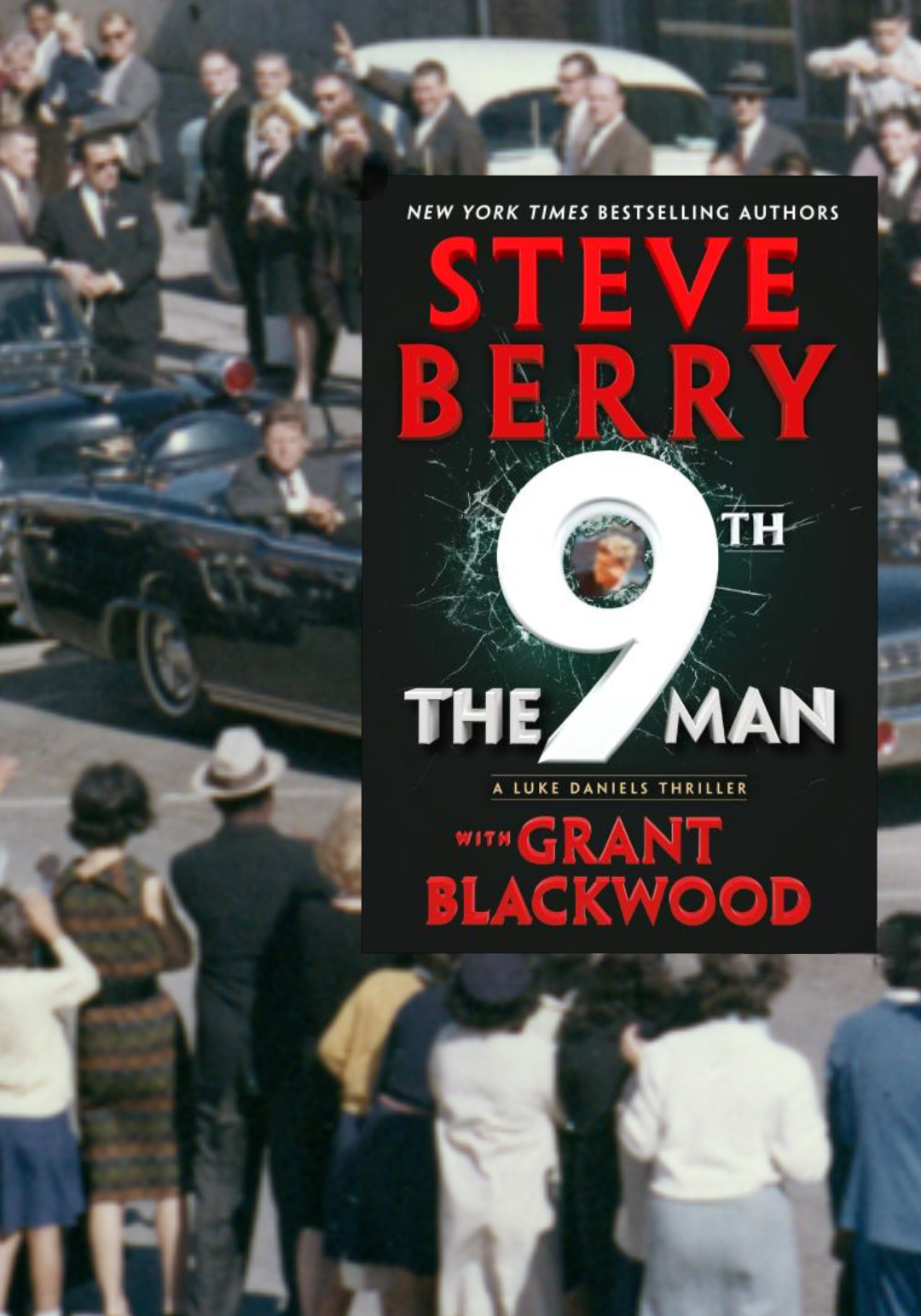
The 9th Man. Steve Berry and Grant Blackwood.  Grand Central Publishing, 2023.  368 pages.  Book 1 of 2 (so far) Luke Daniels novels.

I recently read and enjoyed the first Cotton Malone novel by Steve Berry. While Malone continues his history-based adventures, Berry has teamed up with another author to spin off a new new series featuring a younger associate of Berry. Luke Daniels.  Daniels is another southern gentlemen, like Malone, a former Army Ranger, highly trained and capable, also with a deep knowledge of history.  Same general idea, lots of action, intriguing mysteries, shady individuals, double crosses and triple crosses, lots of weapons, high body counts, and history-shaking secrets revealed.  A second Luke Daniels title was released in 2024, and another is scheduled for release in 2025.

In The 9th Man, Daniels is drawn into danger, by a woman of course, and finds himself locked in a deadly battle with a very powerful and ruthless man who will literally do anything to cover up his role in the assassination of President Kennedy.  It was a fast and enjoyable read.  I'll be reading more Cotton Malone and Luke Daniels books.


Summoned: Frances Perkins and the General Welfare

Tells the story of Frances Perkins, who was appointed Labor Secretary by FDR during the Great Depression. The first female Cabinet member, she created the Social Security program, the federal minimum wage, the 40-hour work week, and ended the legal use of child labor. Featuring interviews with Nancy Pelosi, George Mitchell, David Brooks, Lawrence O’Donnell and Amy Klobuchar.


Dear Miss Perkins:  A Story of Frances Perkins' Efforts to Aid Refugees From Nazi Germany.  Rebecca Brenner Graham.  Citadel, January 21, 2025.  336 pages.  Advance Reader's Copy.

This biography ended up on my favorite ten reads list for 2024.  I always knew Frances Perkins as a footnote, albeit a major footnote, in American history, and I always made sure to mention her when I taught, but I never did her story the justice that she deserved.  American history buffs might recognize her as the first female in the presidential cabinet, serving as FDR's Secretary of Labor.  More than casual buffs might know that she was a literal eyewitness to the Triangle Shirtwaist Company fire, standing on the street below the building as dozens of young immigrant women jumped to their deaths to escape the fire, and that motivated her to become one of the driving forces behind occupational safety and labor regulations that had a tremendous impact on American society.  She became a leading figure in the New York state government administration before FDR took her to Washington, and she continued to make history and real fundamental, lasting changes, making a real case for consideration as the most effective and important American woman in the 20th century.  Yet, few, including history buffs and teachers like myself know enough about the real Frances Perkins.

She had major struggles in her life and career, a husband who spent most of their marriage in and out of mental institutions as a manic depressive, probably what would be bipolar disorder today. She had to deal with the sexism that women in any career faced, especially politics, as she was always the only woman in the room.  She was the object of vitriolic attacks in the press, and voluminous hate mail that accused her of being a communist  and Jewish (She was Episcopalian.).  She was impeached (but not removed) by Congress, and even FDR, who had been an ardent supporter and admirer, turned his back on her when her progressivism threatened his support.  (Another strong, accomplished woman who made him what he was that he betrayed.)  At the time of her tenure, immigration fell under the purview of the Labor Department, and she made it her mission to help refugees fleeing Nazi Germany.  This book gives the reader a look into her phenomenal character and career, particularly this part of it.  She was a real American hero.


Author talk

You Dreamed of Empires.  Alvaro Enrigue.  Translated by Natasha Wimmer.  Harvill Secker, 2024.  224 pages.  

I first saw glowing reviews of this book a couple of weeks ago, reviews that hailed it as original, creative, funny, anti-colonial, genius, etc.  It's mostly an account of the events of one day in history, the day that Hernan Cortex and his conquistadors arrived in Tenochtitlan, the capital of the Aztec Empire, as the guests (or prisoners?) of Emperor Montezuma (Moctezuma II) and a meeting of two vastly different cultures that would prove to be one of the most fateful meetings of history.  My feeling after reading the book?  Meh.  Of course it's anti-colonial, otherwise it would never have been published and would never have made all the media lists of best books of the year.   The Spanish are minor characters in the story, naturally portrayed as arrogant and ignorant buffoons, totally clueless about everything.  The real story is the palace intrigue as Montezuma (Moctezuma) is simultaneously a quivering mass of uncertainty and an all-powerful man-god.  He is so powerful that if one of his subjects commits the smallest infraction of protocol, he simply tells the offender to report to the palace guards to report to the palace guards and tell them to execute him, AND HE DOES!  Yet, these weird visitors have him flummoxed,  his priests advise him that he shouldn't do what his instincts tell him needs to be done, and his empress/sister and subordinates plot against him, so he spends the day eating, napping, bathing, and consuming lots of hallucinogens.  

There's a little humor, a little magic, a little historical accuracy, and a lot of strangeness.  I don't even think it's all that original.  It reminds me of the late 1960s and early 1970s when authors and filmmakers started churning out works that redefined the western - making whites ridiculous and evil, while finally bringing humanity and a more well-rounded characterization to Native Americans.  Overall, I found the book interesting, but overrated.


Author talk

Broadway Butterfly:  Vivian Gordon the Lady Gangster of Jazz Age New York.  Anthony M. DeStefano.  Citadel, 2024.  256 pages.  

In the 1920s and 1930s, there was a group of women who followed their dreams of theatrical stardom to New York City.  There were so many that they were given a name,  "Broadway Butterflies."  Few of them attained stardom, or even work, on the Broadway stage.  Most had their dreams dashed, and some were forced to turn to even less savory occupations in dance halls and nightclubs, or, even worse as kept women, mistresses, or sex workers.  Some found themselves in lives of addiction or criminality, and several were murdered during the Jazz Age.  The most notorious example of the tragic Broadway Butterfly was probably Vivian Gordon.  On February 26, 1931, Gordon's battered lifeless body was discovered in a Bronx park.  The murder led to revelations of her life as not only a prostitute and madam, but also as a blackmailer and extortionist who kept detailed records of important men and their business with her and her girls.  These men were in the top ranks of New York society, business, and government and even included the infamous Judge Joseph Crater, who disappeared, never to be seen or heard from again.  Gordon's murder generated a press frenzy and a public outcry, revealing the entrenched corruption of the New York legal system and the blatant corruption and incompetence of the city's charismatic Mayor Jimmy Walker.  In fact, Walker was a firm ally of Governor Franklin Roosevelt before the murder, but the public nature of the mishandled and bungled investigation led FDR to turn against the Mayor so that his rising presidential campaign suffered no damage.  Was the murderer one of her angry clients, a man afraid that she could testify about the system, of someone else?  DeStefano is a Pulitzer-winning journalist who's written several books about historical organized crime figures, and he takes the reader through Gordon's story, the various theories about why she was murdered, and the political ramifications that resulted.