Showing posts with label #florida. Show all posts

Saturday, January 31, 2026

Shelved: Books Read and Reviewed in January 2026


Stranger in a Strange Land: The Controversy

Stranger in a Strange Land.  Robert A. Heinlein.  G.P. Putnam's Sons, 1961.  408 pages. 

My first finished book of 2026 is a classic.  Published in 1961,  Stranger in a Strange Land  is an iconic science fiction novel that has had a huge influence on modern culture and has been a subject of controversy ever since its publication.  It was awarded the Hugo Prize for best science fiction novel in 1962, it became the first the first sci-fi novel to enter the New York Times Book Review's best seller list, and it has been included as a "Book That Shaped America" by the Library of Congress.  I'm pretty sure my ninth grade English teacher recommended it, and I was a huge sci-fi reader throughout high school, but I'm not sure if I read it then.  It's one of the oldest stories known to man:  the fish out of water, a strange innocent who is thrust into a wicked world, observes the foibles and follies of humanity, is changed by humanity, acquires followers and admirers, and is then destroyed by the world, leaving the possibility of a better world in his wake.  The story's been told a million times, including in the New Testament.  In this case, the Christ figure is Valentine Michael Smith, a human survivor of a Mars expedition as a baby that was raised by the Martians and returned to Earth as a spy, but  a spy with tremendous powers of the mind including telepathy, telekinesis, and teleportation, just to name a few.  After his tutelage under a surrogate father figure, Valentine begins his transformation into a kind of messiah. His exceptional abilities lead him to become many things to many people: freak, scam artist, media commodity, searcher, free love pioneer, neon evangelist, and martyr. Controversy? First, there were objections to the perceived attacks on religion in general and Christianity in particular.  Second, it was one of the first mainstream sci-fi novels to include sex, and not just sex, but lots of nudity and free love,  Finally, there were rumors that the book was a huge influence on Charles Manson and his murderous Family, and these rumors led to the book being removed from libraries across the country.  (Although Manson did make himself into a messiah who demanded free love and group sex for his followers, it is unlikely that he ever read the book since he was functionally illiterate.  However, it is quite probable that some of his better-educated followers had read it, and they used the word "grok" - a word created by Heinlein  for the book to mean a thorough and complete understanding or grasping of a concept.  More recently, Elon Musk decided to name his artificial intelligence app "Grok" - for whatever reasons.)  Some sixty years later, the book is controversial for another reason:  sexism, based on its portrayal of women and relationships.  Sure, but I would argue that you have to look at the time it was published.  Second wave feminism was just blossoming with Betty Friedan and Gloria Steinem still unknown. The sexual revolution was just underway with sexologists like Kinsey, Masters, and Johnson becoming public figures, Hugh Hefner was attempting to create a Playboy world, and the birth control pill was first used in 1960. Sex was emerging into public discourse like never before.   Actually, I think the portrayal of women and sex in the book is very progressive for the time, and, in many ways, women enjoy a state of equality in Heinlein's world that did not exist in 1961 America.  The book is a deeply insightful and thought provoking take on America and American institutions.  


Double Whammy.  Carl Hiaasen.  Putnam, 1988.  320 pages.  Book 1 of 7 in Skink series.

If there was a Mount Rushmore of writers of the "Florida Man" genre of fiction, the faces would be those of Tim Dorsey, Carl Hiaasen, Dave Berry, and Randy Wayne White, authors who excel at creating incredibly ridiculous and exciting stories about heroic, but flawed, Floridians and the assorted crazies that complicate their lives and threaten their friends.  Their stories are all based in and inspired by real events and real history that can only have happened in the Sunshine State, and then they add their own brand of twisted elaboration that makes the genre so unique.  This Hiaasen novel is the first to recount the adventures of private detective R.J. Decker and his partner Skink, a 6' 6 " tall bearded misanthropic hermit who lives in the Florida Everglades and subsists on a diet of roadkill.  While Skink is a legendary character in his neck of the woods, almost no one knows that Skink was actually once the Governor of Florida, Clinton Tyree, the most honest man ever to be governor of any state, so honest, in fact, that he couldn't take the pressure of politics, snapped, and ran away from office to become a crusading environmentalist, carrying on a one-man fight against evil developers.  Skink and Decker find themselves entangled in the dangerous, high-money-stakes, life or death world of professional bass fishing.  A major cheating scandal turns deadly, and bodies pile up/  Oh, and there's a murderer who talks to the dead head of a pet bull that is clamped to his right arm.  Insanity.  Or just another Florida Man story.


Caravaggio Documentary

Caravaggio:  A Life Sacred and Profane.  Andrew Graham-Dixon.  W.W. Norton & Company, 2012.  544 pages.

Inspired by a great exhibition focusing on Caravaggio and baroque art at St. Petersburg's (Florida) Museum of Fine Arts, I purchased this biography and found it to be a truly great one.  Michelangelo Merisi da Caravaggio, usually known simply as Caravaggio, was, and is, the greatest artist of the baroque, and his influence continues to resonate throughout the artistic world.  Filmmaker Martin Scorsese recognizes often describes the huge influence Caravaggio is on his own films with the look, the stories, and the characters very visibly reflecting elements of the painter's life and world. Caravaggio pioneered the use of light and dark as key elements in his work, and his paintings are full of life, action, and vibrancy. The paintings all tell vivid stories.  Since his patrons were often Catholic Church officials who sought to use the power of art as propaganda, designed to win the hearts and devotion of the people who might otherwise be tempted by the Protestant Reformation, he often painted gritty, often bloody, scenes of Old Testament battles and violence and of the horrific martyrdoms of saints murdered for spreading the gospels of the New Testament, often shocking his patrons and other viewers with their graphic brutality.  His personal life was equally profane.  He was either homosexual or bisexual at a time when that was punishable by death.  He was known for engaging in drunken, violent brawls, roaming the city with like-minded young troublemakers, and associating with prostitutes and pimps.  Sentenced to banishment and death for killing a rival in a duel, he was forced to live a life on the run, before he himself died, under mysterious circumstances, at a very early age.  He still managed to create a revolutionary body of work.  This bio covers his life and his works thoroughly and is equally as masterful as his work.  


White Shadow.  Ace Atkins.  Putnam, 2006. 384 pages.

This is the second work of historical fiction based on a real-life crime written by Ace Atkins that I've read.  Devil's Garden was about Roscoe "Fatty" Arbuckle's trial for the death of a would-be actress in 1921.  White Shadow is about the 1955 murder of Tampa Florida organized crime boss Charlie Wall.  Living in Tampa Bay, this  book is of particular interest because of the connections to history and locations in Ybor City in particular and the area in general.  I've read several books, attended talks, and taken tours on the subject of the organized crime that dominated much of Tampa's 20th century history, so a lot of this book is very familiar, and it's always fun to make historical connections as I travel around the city.  Having read two Atkins books, I've drawn some conclusions.  In Ace Atkins' world, the 1920s and the 1950s were very similar, whether the location was San Francisco or Tampa.  Everybody was always depressed, angry, miserable, and morally ambiguous.  Everybody had lots of really bad and unpleasurable sex with lots of different people, and that sex usually involved tears, violence, and lots and lots of alcohol and/or drugs.  Love doesn't exist, but drugs, alcohol, guns, gambling, prostitution, and many other vices were openly available everywhere.  Everybody talked like Rocky and Mugsy, the gangsters in the Bugs Bunny cartoons, all of the time (In Tampa, though, it was with a Cuban or Italian accent.). I know Atkins is a huge admirer of the detective noir genre and especially Dashiell Hammett, but it's just soooo much for sooooo long -  the books go on and on and on, far too long.  I really want to like his books more than I do.  His most recent book, a Cold War spy thriller, is set in Atlanta in the 1980s.  I haven't decided if I'm up for reading what Atkins does to make that setting depressing for me.  


Author talk

King of Kings:  The Iranian Revolution:  A Story of Hubris, Delusion, and Catastrophic Miscalculation.  Scott Anderson.  Doubleday, 2025. 512 pages.

The Iranian Revolution and the resulting American hostage crisis happened exactly because of the reasons cited in this book's title:  hubris, delusion, and miscalculation. Add stupidity, incompetence, impotence, and entrenched bureaucratic insanity.  Shah Mohammad Reza Pahlavi  was one of the most ill-suited men ever to be called "King of Kings."  He was not that bright and had led a totally isolated and exalted life from his birth that separated him from reality.  He had almost no competent advisors that ever dared to tell him the truth.  Negative reports and statistics were routinely changed to positive ones before they were presented to him.  He was incapable of making decisions, especially under duress.  Instead, he relied on others to take action and, consequently, to take the blame if the action failed.  Jimmy Carter was an inept, incompetent boob, totally in over his head from the second he stepped into the White House.  Like the Shah, he was far too involved in petty details, didn't have competent and honest advisors, but he was further handicapped by his outsider status that made him the subject of ridicule, mistrust, and derision by the Washington bureaucrats and professional politician class who actively kept information from him and had no interest in carrying out his policies.  Neither man saw the world as it was.  Ayatollah Ruhollah Khomeini was a provincial hard-line religious zealot who had no idea about or interest in how a country should be run.  His small group of advisors rallied around him simply because he was a viable alternative for the people's support and ignored his brutal medieval core philosophy.  A coalition of wildly disparate factions including socialists, communists, modernists, republicans, and religious fundamentalists came together, only united by their desire to depose the Shah, and they each thought Khomeini could be used to attain their goal and then discarded, but almost none of them had any real confidence that a revolution would be successful.  The CIA was totally incompetent (as usual), reporting to the White House, even days before the revolution, that the Shah was secure in his position for decades to come.  The US Ambassador to Iran was an idiot, and embassy and consulate officials in Iran were not Iranian experts and couldn't even speak the language, just marking time until their next ill-fitted posting.  They routinely ignored and buried the reports and observations of the one staffer who saw what was happening well before it did, and he was threatened with dismissal and frozen out of any meaningful role within the staff.  Scott Anderson does a fantastic job of explaining what happened and why in this book, and it is incredibly readable.  This is the book to read if you want to know about modern Iranian history and the history of the revolution, the effects of which still resonate almost 50 years later. 


Author Talk


Recipes From the American South.  Michael Twitty.  Phaidon Press, 2025.  432 pages.

This book is a must-have addition to any cookbook or southern history or southern food library.  It's the southern version of Julia Child's Mastering the Art of French Cooking in terms of scope and importance.  Michael Twitty has become one of America's greatest culinary historians.  He started out as a re-enactor, researching and demonstrating the foods and foodways of the American South that resulted from the blending of West African, Caribbean, Native American, and European cultures that resulted from the African diaspora and slavery.  His work illustrates both the importance of food history and the power of food to cross boundaries, erase differences, and unite people.  However, the region is vast, and even southern food is not monolithic.  Twitty presents 260 recipes that cover the entire breadth of southern cuisine.  The recipes are tested and prove, the photos are beautiful, and there are short histories of each dish.  Cooks will discover familiar recipes for dishes that their families have made for generations, but they will also discover new recipes and learn things about the old and the new in the process.  I've made some of the recipes and I will be making more, and the book has already become a first reference for me.  It is definitely a classic that should be on any southern cook's shelf.


The Buffalo Hunter Hunter.  Stephen Graham Jones.  S & S/Saga Press, 2025.  448 pages.

Stephen Graham Jones is apparently a very successful writer of western horror fiction, lauded by authors like Stephen King and Tommy Orange and often compared to Cormac McCarthy, but I had never heard of him until his newest book appeared everywhere, including on practically every "Best of 2025" list that I saw.  A diary written by a Lutheran minister in Montana in 1912 is discovered and examined by an academic who happens to be his direct descendant.  The minister recounts stories told to him by a Blackfoot Indian named Good Stab, stories of a flesh-eating, blood-sucking supernatural vampire roaming the plains out for revenge.  What's not to like, right?  It's my first Did Not Finish of the year, after about a fifth of the way through.  It is - incredibly - mind numbingly BORING.  First of all, it's a story within a story within a story, so there is a huge gulf between the reader and the "action."  Secondly, the language is stilted and tedious.  The creature doesn't just attack and eat animals, it eats "big mouths," "little mouths," "prairie runners," "whitehorns," "blackhorns," "long legs," "dirty faces," "moving shadows," and "wags-his-tails."  What? What's that? Huh?  Finally, its pace is not slow; it's plodding and ponderous, a real slog.  Multiple times, I realized that the creature was eating, and I thought "Wait, what happened?"  I see references in reviews and summaries to extreme violence and gore and found myself in the middle or at the end of such scenes without knowing how I got there.  This is a terrible book.  


Scene from "The Reivers" 1969

The Reivers.  William Faulkner.  Random House, 1962.  320 pages.

The other day, I noticed Turner Classic Movies was airing 1969's "The Reivers" starring Steve McQueen, and I tuned in for a few minutes.  I decided to make the book my second classic read of the year.  Published by William Faulkner in 1962, it was awarded the Pulitzer Prize in 1963, making Faulkner only the fourth author to win two Pulitzers.  I've read a few Faulkner classics, and admire his work, but The Reivers  is different.  Perhaps Faulkner's most accessible book, it's a comedy, a picaresque novel, that is an adventure story in which a naive or roguish, or both, hero goes on an adventure, encountering unusual characters and real world issues and corruption along the way.  In this case, it's 11-year old Lucius Priest, a resident of  Faulkner's Yokanaptawpha County Mississippi, who unwittingly gets dragged into Boon Hogganbeck's crazy scheme.  Boon works for Lucius' grandfather, but one day he decides to steal or borrow the grandfather's car, one of the only cars in town at the time, and go to Memphis.  A few miles out of town, they discover that Ned McCaslin, a black man and fellow employee of the grandfather and an actual blood relative of Lucius, had stowed away in the car.  Together, they head off to Memphis, landing at a brothel run by Miss Reba, and Boon gets reacquainted with his favorite girl, Miss Corrie.  Long story short, Ned trades the car for a race horse, and they plan to run a race in order to win the car back.  Hijinks ensue.  It's not a bad story and a very different side of Faulkner.  Probably 3 or 3.5 out of 5 for me, mainly because I 'm not really a fan of  horse racing.


CBS Sunday Morning segment

The Barn: The Secret History of a Murder in Mississippi.  Wright Thompson.  Penguin Press, 2024.  448 pages.  

Place.  It is one of the most vital elements of the study of history.  It acts as a physical, emotional, and cognitive anchor, a three-dimensional primary document that transforms abstract events from the distant past into tangible, relatable experiences, providing invaluable context to the events that happened upon it and to the lives of the people who lived there, worked there, fought there, loved there, and died there. "Place" provides a connection that is not possible otherwise.  Think about the feeling you have on a battlefield or in a home or site, when your senses take it all in and  often both a new understanding and a new curiosity arise.   I've read very few books in my life that capture place as well as this book does.  Wright Thompson has mastered the craft and can teach lessons on the subject.  I've had this book ever since it was released, but I've only read it in the past few days.  After all, I knew the story of Emmett Till, I taught the story of Emmett Till every year, and  I knew it would be a tough read emotionally.  And it definitely is. It makes you despair and lose all hope for humanity (if you had any at the start).  If you know it, it makes you hear Nina Simone's song "Mississippi G*****n" on a constant loop in your head, and makes you believe that the world and country would be much better off if Mississippi had never existed, or at least hadn't been settled by any new humans after 1600, that Mississippi is hell on earth, populated by the moat deranged and depraved "people" in history.  (And when a native Georgian now living in Florida  says that, that's saying something.)  It is not all depravity, however.  The reader is introduced to some truly brave and heroic people that are usually not a part of the story:  friends and relatives of Emmett and his mother, witnesses who were previously ignored by the law and by the media, and people who have devoted their lives to keeping the story alive in the 7 decades since. This is not only a new history of the kidnapping and murder of a 15-year old boy and the intense and coordinated effort throughout the state over the ensuing decades to erase it from history and from the minds of white and black Mississippians, but it is also a history of Mississippi, the place, going back to before European contact and encompassing every aspect of its history.  The barn in which Till was tortured, mutilated, and murdered is like an epicenter of that history.  The Delta Blues were born, King Cotton thrived and collapsed, Indian villages were decimated, and the Archie Manning football dynasty was born, all within a few miles of the nondescript farm shed.  All of that comes to life in this book.  This book should be the required textbook for Mississippi state history classes. It should be required reading for all Americans.  


Sunday, December 1, 2024

Shelved: Roundup of Books Read and Reviewed in November 2024


Authors Talk


The Cuban Sandwich:  A History In Layers.  Andrew T. Huse, Barbara C. Cruz, and Jeff Houck.  University Press of Florida, 2022.  180 pages.

Every state has a couple of foods that Americans associate with that state.  In Florida, it's most likely key lime pie and the Cuban sandwich.  Personally, I think smoked mullet is a much bigger and better contribution to food than those two combined, but they are the quintessential Florida foods in the minds of most Americans.  

The Cuban sandwich has a long history of popularity, but both its composition and its origin have been clouded by conflicting claims and stories.  Tampa, Miami, and Key West all claim to be the home of the sandwich, which typically consists of some combination of pork (ham, roast pork, pulled pork), Swiss cheese, mustard, and pickles on Cuban bread.  Tampans add salami, a heresy according to other aficionados.  While the origin story has been researched before, authors Huse, Cruz, and Houck felt that there was more to the story and that it hadn't been fully told.  After extensive research, and I'm sure countless Cubans, they've created this fantastic history and a great read.  I have always believed that food is an excellent entry point when studying history, and this book delivers.  Their research reveals that Cuba was known for its sandwiches even before the Spanish-American War, even before the word sandwich reached Cuba, and they were often considered treats for upper class Cubans out on Sunday strolls.  There were different sandwiches with different names.  One of those sandwiches, called a mixto by most Cubans, eventually made its way to the United States, probably with immigrants to New York City.  The original sandwich looked very different, often including turkey or chicken, and/or lettuce and tomatoes. When Cubans settled in Florida, the sandwich went from upper class treat to staple for workers in cigar factories and other occupations.  The authors have done a delicious job of presenting Cuban and Florida history in all of its layers, and, along with the history, they include really interesting profiles of people and businesses that have made and continue to make contributions in Cuban sandwich-ology.


Kissinger's Betrayal:  How America Lost the Vietnam War.  Stephen A. Young.  RealClear Publishing, 2023.  432 pages.

Henry Kissinger's recent death at age 100 marked the end of a roughly 70 year career as academic historian, National Security Advisor, Secretary of State, and advisor to a dozen presidents.  He shaped much of America's Cold War policy and history, and he became one of the most powerful and influential men in all of American history, credited with overseeing detente with both the USSR and the People's Republic of China and negotiating the Paris Peace Accords that ended US involvement in Vietnam.  His legacy is incredibly complicated, and historians will be struggling to unpack it and sort it out for decades.  Was he a genius diplomat  who worked tirelessly to achieve peace or was he a war criminal whose actions brought death and suffering on a huge scale, ultimately thwarting peace and stability?

Author Stephen A. Young's book tackles this question of legacy head-on, and one can correctly infer from the title what his opinion is.  Young was on the ground during the Vietnam War, tasked with building support for South Vietnam's government amongst the local populations as part of the US-sponsored CORDS program.  He went on to become an academic and think tank director.  Here, he relies on formerly classified documents in American, Vietnamese, and Russian archives, numerous interviews, and especially the personal papers of U.S. Ambassador to South Vietnam, Ellsworth Bunker to accuse Kissinger of turning his back on the people of South Vietnam, deceiving President Nixon and other Cabinet members, along with the South Vietnamese President Nguyen Van Thieu, causing the collapse of South Vietnam when it could have survived otherwise.  He makes a compelling case, and the background  and history of the Vietnam conflict are phenomenally presented.  However, it is obvious that Young does have a particular agenda, and his interpretations differ from the accepted view.  For example, while conventional wisdom often portrays Nguyen Van Thieu as extremely corrupt and incompetent, I think Young portrays him almost as admirable, even heroic.  And, of course, we will never know for sure if South Vietnam could have survived American withdrawal under different conditions.  Biased as the author as, I still think the book adds to the history of the Vietnam War.


Author talk

Mermaid Confidential.  Tim Dorsey.  William Morrow, 2022.  368 pages.  (#25 of 26 Serge Storms novels)

With national and world events in the state they're in, I felt the need for a quick for a quick mental palate cleanse, and what could be better than the continuing adventures of my favorite psychopathic, history-loving, serial-killing vigilante, Serge Storms.  Serge is the creation of Tim Dorsey, the brilliantly twisted comic genius who unfortunately passed away far too early, one year ago this month.  Serge Storms is a manic, obsessive, super-intelligent anti-hero who is Florida's biggest fan and supporter, constantly dispensing knowledge about everything Florida - history, culture, flora, fauna, climate, geology, all things Florida.  He travels the state with his best buddy Coleman who is decidedly not intellectual and is, in fact, drunk and/or stoned most of the time.  As they pursue their Florida adventures, they encounter really good people who have been grievously wronged by really bad people, and Serge goes into full vigilante mode, devising incredibly ingenious plots to exact revenge and set things right.

Mermaid is a love letter to the Florida Keys - and, yes, the Keys are a strange and different place from even the rest of Florida - and the reader learns about real locations, events, and cultural touchstones that make the Keys unique, including learning about Florida condo living, charter boat fishing, drug smuggling, cartel wars, and money laundering. (There's even a chapter set in Forsyth, Georgia that caught me by surprise.)  The Serge novels are always fun and always educational.  I'm glad that I have about 20 more to read, but sad that there aren't more to come.  Why isn't there a Serge Storms TV series yet?  Just begging for Danny McBride to produce it.


Audiobook preview

The Templar Legacy.  Steve Berry.  Ballantine Books, 2006.  496 pages. (Cotton Malone series, book 1 of 19)

Did you read the The Da Vinci Code twenty years ago, like everybody else?  I did, and I remember enjoying the ride but feeling very unsatisfied upon completion, much like I felt with the tv show "Lost" (but not as intensely unsatisfied as I felt with "Lost").  In 2006, author Steve Berry began the adventures of Cotton Malone, a highly capable federal agent who retired to become an antique book dealer in Copenhagen.  When his former boss has personal business in Copenhagen and pops in for a social visit, he finds himself embroiled in a mystery that disrupts and threatens not only his life, but the very foundations of western history and Christianity,  a mystery involving the Knights Templar.

The Knights Templar order was an order of holy warriors formed during the Crusades in Jerusalem in 1118.  Over the next two centuries, the order enjoyed favor and support from popes and secular kings, accumulating great power and wealth.  Then, in the early 1300s, Pope Clement V, at the behest of French King Philip IV, declared war on the Knights Templar.  The Templars were charged with blasphemy, greed, and all forms of sexual deviance.  Thousands of Templars were brutally tortured and executed, their assets were seized, and the order was abolished.  Or was  it?  Over the next seven hundred years, legends grew of hidden Templar treasures and lost Templar knowledge.  Ex-agent Cotton Malone finds himself deeply involved in the Templar legend.  

If you like mysteries grounded in real historical events, the Cotton Malone series is a series that you would probably enjoy.


A "best of" compilation

Don Rickles:  The Merchant of Venom.  Michael Seth Starr.  Citadel, 2022.  352 pages.

Gen Xers and Baby Boomers definitely know who Don Rickles was.  He was a comedy legend for decades even though he polarized audiences throughout his career.  Fitting, because he was really two different people.  In real life, he was a shy, quiet, introverted mama's boy, and his friends described him as incredibly kind, sweet, loving, generous, and loyal.  On stage, he viciously attacked everybody, celebrities and civilians alike, making jokes that broke every single taboo and crossed every line, without regard to race, religion, gender, sexuality, politics, handicaps, and physical appearance.  He was an equal opportunity offender, a lifelong Democrat who was friends with Ronald Reagan and George H.W. Bush.  Most of his targets took it in stride, believing that an insult from "Mr. Warmth" meant that you had made it. Others took the insults to heart.  Audiences were divided as well, but Rickles zoomed to the top of his field, dominating stages and becoming a fixture on television in the 1960s, 1970s, and 1980s.  This biography is an informative and thorough recounting of his career, but it's somewhat superficial.  There are no deep, dark personal tragedies, no alcohol, drug, or sexual abuse, no deep dives into anyone's psyche.  However, that might be appropriate considering that the subject himself built an impregnable wall that separated his public and private personas.


Audiobook Preview

The Maltese Iguana.  Tim Dorsey.  William Morrow, 2023.   336 pages.  Serge Storms series, #26 of 26.

I escaped again to Tim Dorsey's brilliantly hilarious Florida Man world, reading the last Serge Storms novel, published in 2023.  But is it really an escape from real life?  Dorsey's books are all filled to the brim with real life since plot lines are all taken from real life, and my favorite psychopathic history-loving serial killer Serge Storms dispenses more Florida history knowledge than any professor in each book, but the story is always presented in an unbelievably surreal and hysterically funny way.  SERIOUSLY, WHY ISN'T THERE A DANNY MCBRIDE-PRODUCED SERGE STORMS TV SERIES?  

In what is sadly the final chapter of the series, Serge and his buddy Coleman are loving life in their Florida Keys condo, all settled in to the routine of weekly game nights and spaghetti and meatballs potlucks with their neighbors, but then the pandemic hits, totally upending their world.  As if that wasn't enough, they find themselves enmeshed in an overcomplicated CIA debacle, allowing Serge to expound on fifty years of CIA history in addition to Florida Keys history and Florida movie history.


Author podcast appearance

Eden Undone:  A True Story of Sex, Murder, and Utopia at the Dawn of World War II.  Abbott Kahler.  Crown, 2024.  352 pages.  

Take a handful of crazy Germans and a barren rugged flyspeck of an island in the Galapagos Archipelago in the chaotic decade of the 1930s, throw in a few American millionaire adventurers and a murder mystery, and you've got one hell of a story.  Narrative nonfiction author Abbott Kahler recognized the hook of a great story and told it in Eden Undone.  Kahler, the author of great books like The Ghosts of Eden Park, Sin in the Second City, and Liar, Temptress, Soldier, Spy. recently changed her name to avoid confusion with another author named Karen Abbott.  After she discovered the story, she learned that movie director Ron Howard had also discovered it, making his own movie adaptation of the story, set for release in the very near future.

The first crazy Germans central to the story are an unhappy housewife diagnosed with multiple sclerosis and an arrogant doctor who detests sick people, follows the philosophy of Friedrich Nietzsche, and believes that a life of primitive living, vegetarianism, and nudism will enable him and others to live to be 150 or older.  They meet, fall into something (love? not like you've known it hopefully), convince their spouses to "free" them, arrange for their spouses to move in together as husband and wife, and decide to move to the island of Floreana to establish their own personal utopia.  Once settled on the island, word gets out in the world press, and they're joined, despite their objections,  by a German couple looking for their own slice of Eden and a baroness with her two male sex slaves who plans to make Floreana a resort city for the wealthy, a new Miami Florida.  Lots and lots of tension ensues, and ultimately the baroness and one of her slaves disappear, never to be seen or heard from again.  "Gilligan's Island," it ain't - unless you picture an S&M, fetishistic version with elements of "Desperate Housewives," and Ryan Murphy productions thrown in.  It's a fantastic story that proves truth is stranger than fiction, and this is a great book.  I read it over the course of two days.


Audiobook preview

The Big Bamboo.  Tim Dorsey.  William Morrow, 2006.  352 pages.  Serge Storms series, book 8 of 26.

In this, the 8th of 26 titles in the Tim Dorsey series relating the adventures of history -loving psychopath Serge Storms, Serge and his best buddy Coleman indulge Serge's current obsession with movies.  Serge's search for inspiration to fuel his screenwriting efforts takes them on a madcap dash through Tampa, Orlando, and Miami before a family tragedy leads to the next logical location:  Hollywood.  In Hollywood, Serge lands smack-dab in the middle of a chaotic scene involving two incredibly sleazy film-producing brothers, who make Serge look like Mr. Morality, Japanese organized crime hitmen, and murderous Alabama rednecks out for revenge.  The plot is, of course, overly complicated and involves a huge cast of characters - true for every Serge Storms novel - but all the loose threads come together in the end, and of course, there is lots of history and lots of mayhem along the way.  Honestly, this may be least favorite Serge novel so far, but I still love the series and want more.


The 1853 Dinner Party inside the Dinosaur described in the book


Dinosaurs at the Dinner Party:  How an Eccentric group of Victorians Discovered Prehistoric Creatures and Accidentally Upended the World.  Edward Dolnick.  Scribner, 2024.  352 pages.

Natural history was all the rage in Victorian England.  It seemed that everyone spent their leisure time communing with nature, walking, climbing, and beachcombing, collecting animals, plants, rocks, and fossils.  They assembled personal collections which they proudly displayed, museums were established and attendance bloomed, and scientific lecturers drew standing room only crowds across the country.  Scientists who were charismatic and attractive had audiences of adoring female fans hanging on every word.  The prevailing attitude was that God had created a perfect world functioned smoothly according to his plan, and that science existed in order to prove and illuminate His work.  That worldview began to deteriorate around 1800 when fossilized remains of previously unknown creatures were discovered and studied.  They had been found before, explained away as dragons, cyclops, unicorns, animals that didn't catch Noah's ark, fakes planted by either God or Satan to confuse, but a handful of people began looking at them differently, and their claims shook the Victorian mindset, raising confounding questions.  How can this be when the earth is only 6,000 years old?  Extinction was impossible -how could God make that part of His plan?  How could there possibly have been an entirely different world with entirely different creatures long before Man ever arrived on the scene when the world was created for Man to enjoy?

This book is incredibly entertaining and educational as it describes the work of these important, and eccentric, pioneers, the discoveries and theories that preceded their work, and the effects of their work on Victorian thinking.  It's one of my favorite reads of the year so far.  


Sunday, March 31, 2024

Shelved: Roundup of Book Posts March 16 - March 31, 2024


Discussion of Men's Adventure Magazines

Weasels Ripped My Flesh! Two-Fisted Stories From Men's Adventure Magazines.  Editors Robert Deis, Josh Allen Friedman, Wyatt Doyle.  New Texture, 2013.  436 pages.

As Co-Editor Wyatt Doyle writes in the forward,  "If you want to know where a society's head was at, dig thorough their stuff." If you want know where American men's heads were at in the 1950s, 1960s, and early 1970s, check out the Men's Adventure magazines that were popular during the day.  They were sort of like comic books for adult men or a continuation of the action-packed, and a little seedy, dime novels popular in the late 1800s.  Looked down on as low-brow and slightly pornographic, these magazines published crime, fantasy, sci-fi, and war stories, often written under pen names by writers who would become famous novelists, with titillating and graphic illustrations aimed at males yearning for adventure.  Doyle continues, " The magazines were entertainment, first and foremost, diversion without pretension. They were impulse buys, aimed well south of the brain for the softer targets of gut and groin.  Cheap, lurid, and sensational."

Weasels is the first collection edited by Deis, Friedman, and Doyle in the Men's Adventure Library.  (Check out the website https://www.menspulpmags.com/) They've collected a representative sample of stories including ravenous packs of wild animals, Nazi experimentation, jungle escapes, crime, war, etc.  Totally politically incorrect on many levels because they are sensationalized versions of  their time, but entertaining and revealing.  


Author talk

Backroads of Paradise:  A Journey to Rediscover Old Florida.  Cathy Salustri.  University Press of Florida, 2017.  256 pages.

As part of the New Deal in the 1930s, the federal government extended paychecks to writers, artists, actors, and other creative professionals by employing them in various cultural pursuits. The Federal Writers Project hired writers to submit historical and cultural stories that have proven to be invaluable to later historians, the well-known slave narrative interviews, for example.   In Florida, writers plunged into the largely undeveloped state of the time and submitted accounts of 22 driving tours, exploring the small towns and natural wonders of the state.  These stories, written anonymously by writers including Zora Neale Hurston and Stetson Kennedy,  were collected and published as a guidebook to the state that was largely unknown and unfathomable to most other Americans (still is).  The guidebook became a time capsule of sorts as the interstate system and the tourism industry transformed these small towns and the Florida of the 1930s forever.  Some of the towns stagnated and even disappeared, wilderness was leveled, and ways of life and industries like cattle and citrus started the decline which continues today.

A few years ago, journalist Cathy Salustri was inspired by the guidebook to recreate the road trips and to compare the two Floridas.  She traveled roughly 5,000 miles, and her book becomes a new guidebook, inviting the readers off the interstates and away from the strip mall-, car wash-, and storage unit-filled, traffic-congested homogeneity that Florida is becoming.


Author talk

Homage:  Recipes and Stories From an Amish Soul Food Kitchen.   Chris Scott.  Chronicle Books, 2022.  272 pages.

I love food and cooking and the huge role food plays in culture and history.  If you had told me that one of the greatest books I've seen about soul food in the past couple of years was about AMISH SOUL FOOD, I would have called you crazy.  But here it is, and it's a great addition to my cookbooks.

Chef Chris Scott is a former competitor on "Top Chef" and a successful restaurateur, and his book is a really personal history of his family history, the African Diaspora, and the Pennsylvania Dutch/Amish immigrant experience.  His formerly enslaved ancestors left the South after the Civil War and settled in Pennsylvania Dutch territory, and they blended their African, southern, soul food with the Amish traditions of their new home.  That's how food and culture work, always blending and evolving.  And why shouldn't these seemingly distinctive foodways blend?  What is soul food but food that takes you home to family, traditions, and history and comforts you?  So every culture has its own version of soul food.  Scott grew up with both soul food traditions, and he makes it his mission to prepare and serve food that showcases all of the elements of his background.

The book has great stories, absolutely beautiful photos - some of the best photography I've seen in recent cookbooks, and delicious recipes that I look forward to trying soon.  


Audiobook Preview

The Rumor Game:  A Novel.  Thomas Mullen.  Minotaur Books, 2024.  368 pages.

You may know Thomas Mullen from his Darktown series, novels about the first black members of the Atlanta Police Department and the barriers they faced.  He's back, and he's switched things up.  Instead of the pervasive and overwhelming racism of 1950s Atlanta, Mullen's new novel takes on the pervasive and overwhelming racism of World War II Boston.  But wait there's more:  Boston is not just incredibly racist, it's also a city of pervasive ethnic and religious hatred, affecting everything and everyone.  

The Rumor Game has all the hallmarks of a new series.  The two protagonists are Irish Catholic FBI Agent Devon Mulvey, a rakish rule-breaking, impetuous young agent who has to fight anti-Irish and anti-Catholic discrimination within the Agency, and Anne Lemire, a young half-Catholic and half-Jewish reporter, part Lois Lane and part Nancy Drew.  Mulvey's job is to keep an eye out for cases of industrial espionage or sabotage that might harm the US war effort.  Lemire's job is to fact-check the plethora of war-related rumors and gossip items that swirl around the city and which are also dangerous to the war effort.  After bumping into each other for the first time since junior high school days in the old neighborhood, they find themselves embroiled in a major plot involving counterfeiting, racist hate-spreading, and insurrectionist conspiracies, and their loved ones are also in the mix.  

The characters are interesting, and the story is good.  If it is the beginning of a new series for Mullen, I'll go along for the ride.  


Crash Course "The Mughal Empire"

The Moghul.  Thomas Hoover.  Public Domain. Kindle, Legare Street Press, 2023. 560 pages.

Are you enthralled by the current remake of James Clavell's Shogun?  When the original miniseries aired in September 1980, I was a high school freshman, and it quickly became one of my greatest TV memories. I read the 1975 novel on which it was based, and it became a favorite.  I began reading all of the other Clavell books.  Author Thomas Hoover had read the Clavell book also, and said to his literary agent "Why don't I do a Shogun novel set in India? "  The Moghul was originally published at about the same time the original Shogun series hit TV screens.  (The Moghul also received the TV series treatment, in two other countries, not the U.S.) A friend recently suggested Moghul, and it's free on Amazon Kindle, so why not?

There are many similarities. Both books are set in approximately the same time, early 17th century.  The leading character in both books is an English seaman (pilot in Shogun, captain in Mogul) leading a mission to a thoroughly foreign and strange place to initiate trade.  Both men have to deal with evil and corrupt Portuguese priests and merchants who will do anything to preserve their commercial and spiritual monopolies.  Both men find themselves embroiled in extremely complicated political struggles, plots, and civil wars that weaken Japan and India.  Both men find forbidden love with native women.  Both men are seen and treated as barbarians by their hosts, but they witness horribly bloody actions that make their hosts barbarians in their eyes.

The Moghul was entertaining but falls far short of Clavell's work.  I found myself skimming a lot, partly because Clavell did it so much better and partly because Hoover's intricate and elaborate political and economic explanations were too complicated and boring for me.  I don't remember Shogun being that hard too follow (But I was a high school freshman, so, of course, I was much smarter then.).  As far as I can tell, and as much as he explained in his notes, Hoover did do a good bit of research, so the historical glimpse of Moghul (Mughal) India was interesting.  Overall, I give the book a 3 out of 5.


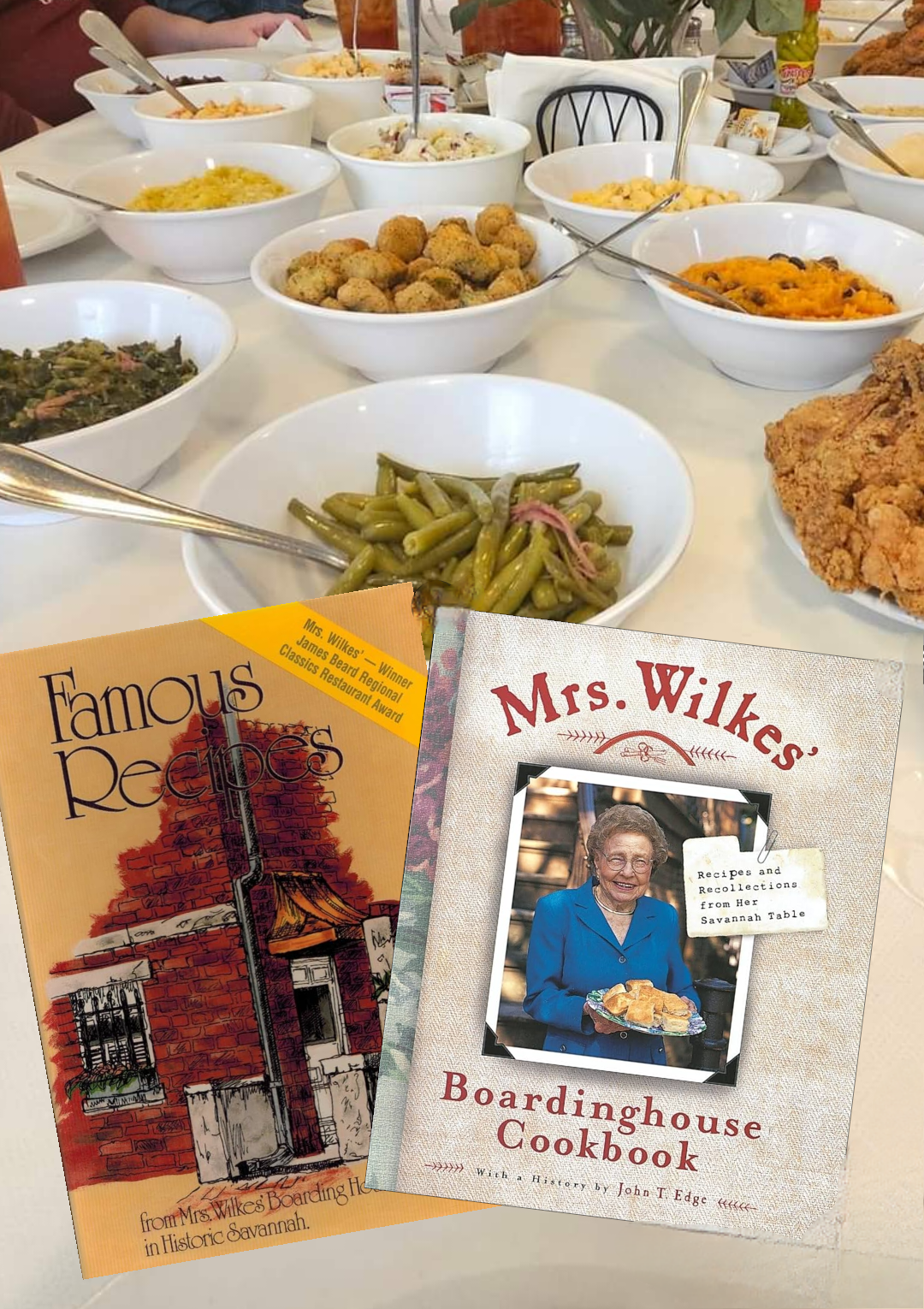
Famous Recipes from Mrs. Wilkes' Boarding House in Historic Savannah.
Mrs. Wilkes' Boardinghouse Cookbook.

Why did it take me so long?  I grew up knowing about Mrs. Wilkes Boarding House.  I knew she and her husband were from my hometown, and her husband may have been related to me --- my maternal great, great grandmother was a Wilkes.  Mrs. Sema Wilkes took over the Savannah Georgia boarding house, already up and running for decades, in the 1940s, providing rooms and meals to railroad men and other travelers.  It's still run by the family, with her granddaughter there most days. I knew that people lined up to eat old-fashioned southern food there, and that it is one of the most famous restaurants in the city. Yet, I had never eaten there until this past February, because of the long lines, schedules not working out, and maybe fear of being disappointed.  It turned out to be one of the greatest meals of my life, hands down, and, offhand, I can't think of any other restaurant that has lived up to its own reputation as well.

The restaurant is only open on weekdays, for lunch only.  People start lining up at 10 AM or earlier, and there are no reservations.  We waited an hour and a half in line, something that I have never done before, for any restaurant.  Usually, if I hear 30 minute wait or longer, I leave.  At 11 AM, they start seating groups of 10 or so strangers at large tables.  The tables are filled with 20 or more bowls of food including fried chicken, roast beef, peas, beans, greens, rutabagas, potato salad, corn, biscuits, cornbread, etc.  Each one is different.  Then, you and your newfound friends start passing the bowls around, and the staff swiftly replaces the bowls as they empty.  Everything was amazing, and continuing the family style-ness, you are expected to clear your own dishes when you leave the table.

As soon as we got home, I ordered copies of two of the books published featuring Mrs. Wilkes' story and recipes.  If you're interested in southern food, these are great additions to your collection.


author lecture


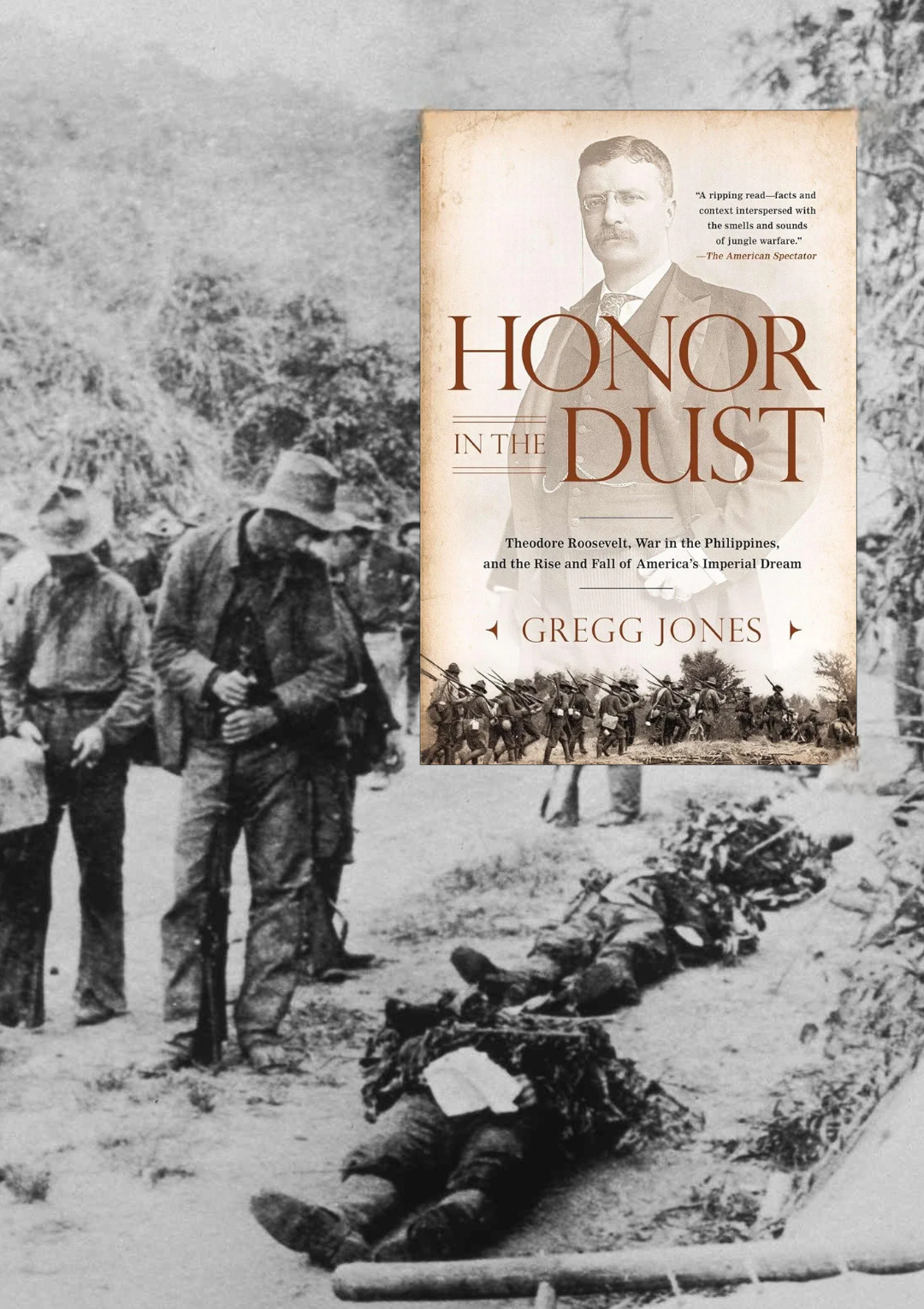
Honor in the Dust: Theodore Roosevelt, War in the Philippines, and the Rise and Fall of America's Imperial Dream.  Gregg Jones.  NAL, 2012. 464 pages.

The Spanish-American War was called "a splendid little war" by Secretary of State John Hay.  It was launched in 1898 from Tampa Florida; a half hour from my house. Within six months, American forces had defeated the cruel and vicious colonial oppressors, the Spanish, liberated the oppressed peoples of Cuba and the Philippines, and acquired overseas possessions which would increase American prestige and economic clout.  Americans had unified in a common effort, helping to heal festering wounds of the Civil War, and (comparatively speaking) few Americans had died.  (The majority of those that did died of disease and bad canned meat, not enemy fire.  For flag-waving politicians and industrialist robber barons, it seemed indeed to be "splendid."

Then, lo and behold, reality set in.  Those ungrateful little oppressed heathens did not possess the common sense to be thankful for swapping Spanish oppressors for American benefactors offering progress, education, civilization, and salvation, that only Americans could bestow.  Whaaaaaatttt? How dare they?  The Filipinos launched a new war for independence which was much less splendid.  American troops were forced by the ungrateful savages into a protracted jungle guerilla war which brought a few thousand more American deaths and tens (maybe hundreds) of thousands of Filipino deaths, committing horrible atrocities against men, women, and children along the way.   

Jones' book is a through account of the Spanish-American and Filipino Wars, America's giant leap into imperialism, and the anti-imperialist movement.  It's a worthy companion read to Stanley Karnow's book about the Filipino War, In Our Image.


Monday, January 15, 2024

Shelved: Roundup of Book Posts January 1 - 15, 2024


Book trailer


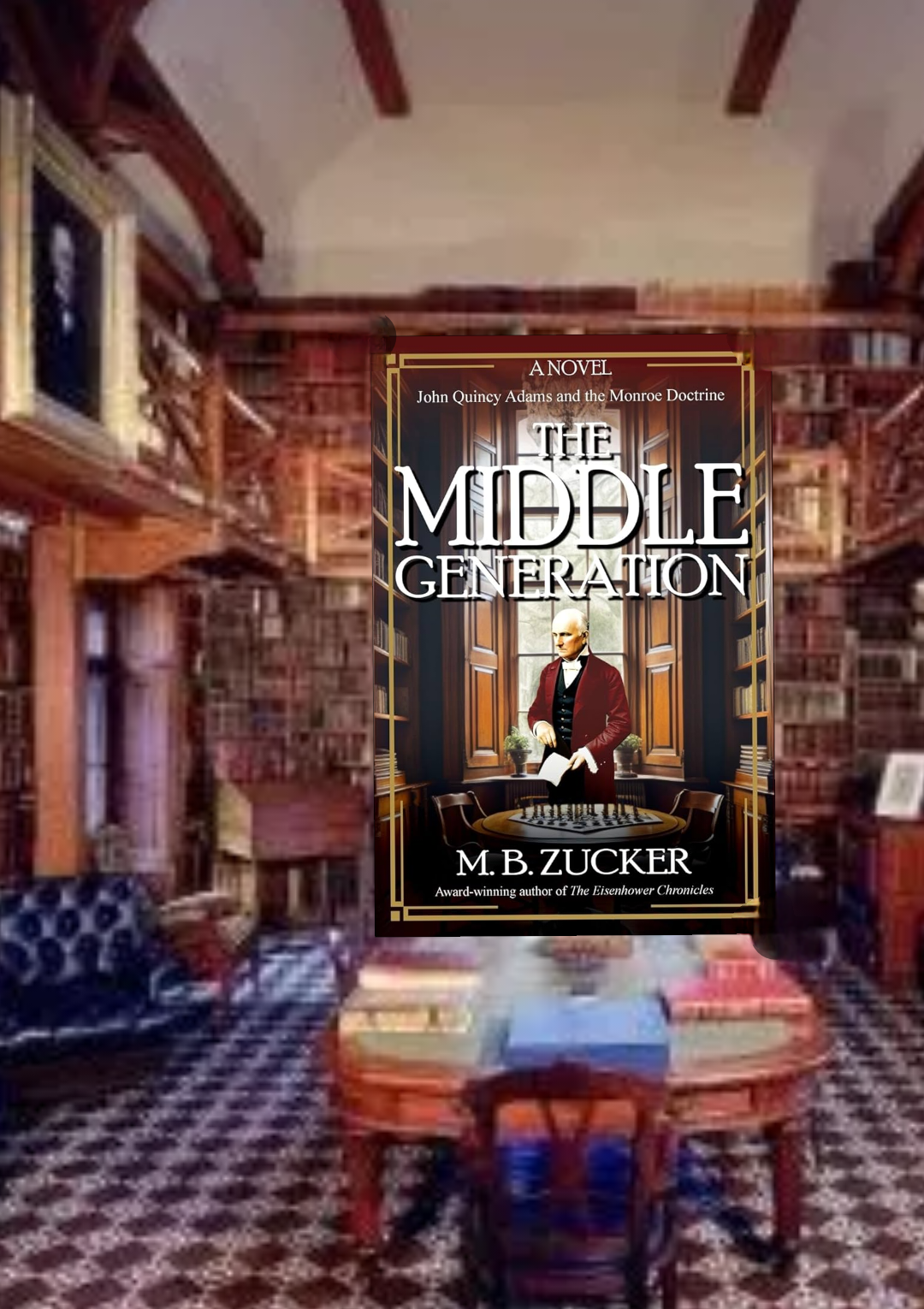
The Middle Generation:  A Novel of John Quincy Adams and the Monroe Doctrine.  M.B. Zucker.  Historium Press, 2023.  507 pages.  


When I first heard of The Middle Generation, my interest was immediately piqued.  Historical fiction about John Quincy Adams, probably the most intellectual president ever and one of the most accomplished American figures in history who is unfortunately often placed on lists of worst presidents ever, set during one of the most critical time periods in American history?  And it was implied that the book was something of a political thriller, well researched by the author who based it on Adams' personal journals and letters.  What a unique idea!  

John Quincy Adams himself represents a major transition between the classical revolutionary America and the America that became a world player.  He was groomed for greatness from childhood b his father and revolutionary leader John Adams, acting as his personal secretary by his early teens, bridging generations of American political leaders. He was the first President to wear long trousers instead of knee britches.  He was a staunch opponent of slavery and an advocate of industrializing and diversifying the national economy.  He envisioned the United States as an equal to the European powers, ready for a seat at the table.  

Like his father, though, he was never a politician,  and he never had the personality for it.  He was blunt, direct, and found social situations and everyday small talk tedious and pointless.  In short (pun, get it?), like his father, he was "obnoxious and disliked."  Quincy comes off poorly in this book, cold and distant, a terrible father and husband.  His constant struggle is to live up to his parents' expectations for greatness and legacy. His wife is portrayed as perpetually miserable, grieving the loss of a child, dealing with Adams' distance, and always overshadowed by her mother-in-law who was a very strong woman and equal partner to husband, yet Quincy never seemed to see Louisa as a real partner.  Their children come across as spoiled, entitled, whiny brattish losers who constantly disappointed their parents and grandparents.

Alas, the book is not a political thriller. Instead, it focuses on Adams' service as Monroe's Secretary of State and his role in securing US borders with Canada, acquiring Florida, and negotiating the Missouri Compromise and the Monroe Doctrine.  It's kind of like a "West Wing" 1820, mostly debates and discussions  with and amongst the President's cabinet, Speaker of the House (and presidential rival) Henry Clay, and various foreign ambassadors.  It's interesting if you're a political wonk, but political thriller it definitely is not.


A review


Atomic Werewolves and Man-Eating Plants:  When Men's Adventure Magazines Got Weird  (Men's Adventure Library).  Robert Deis and Wyatt Doyle, editors.  New Texture, 2023.  328 pages

Men's Adventure Magazines were a popular genre of magazines from the late 1940s into the 1970s.  Each issue was an anthology of adventure stories, crime tales, and science fiction deliberately targeted at young men seeking an escape from their daily lives. While there were a few true stories, most of the stories were fiction, often very sensationalistic, sexy, thrilling, and violent, often set on battlefields, in jungles, or faraway planets.  By today's standards, the tales are in no way politically correct or "woke."  They very much reflect the time period in which they were published, and many wouldn't be published today.  Although some of the authors never really achieved much fame aside from the magazines, many famous authors contributed stories as well, and the illustrations on the covers and in the stories, created by the leading graphic artists of the day, are every bit as amazing as the stories.

Co-editors Robert Deis and Wyatt Doyle began collecting these stories and publishing special editions under the name "Men's Adventure Library."  This collection has everything for lovers of fantasy adventure: werewolves, dinosaurs, mad scientists, supernatural, vampires, killer robots, cryptids, and more.  I enjoy the collections for the stories and the illustrations themselves but also for both the historical subtext and context, providing windows into another time.  


A Splendid Savage:  The Restless Life of Frederick Russell Burnham.  Steve Kemper.  W.W. Norton & Company, 2016.  448 pages.  

Frederick Russell Burnham was one of the best known American men of the late 19th and early 20th centuries.  He was a celebrity whose exploits were breathlessly reported by the press throughout North America, Africa, and Europe.  He was friends with, and admired by,  Buffalo Bill Cody, Theodore Roosevelt, Winston Churchill, Cecil Rhodes,  adventure author H. Rider Haggard, Robert Baden-Powell, and some of the wealthiest men in the world with names like Hammond, Whitney, and Guggenheim, just to name a few.  He was known as the greatest military scout in the world, typically known by the phrase "The American Scout," having served in the Apache Wars, the Ndebele and Shona Wars in South Africa and Rhodesia (now Zimbabwe), the Boer War, and the Yaqui War in northern Mexico in the early 1900s.  He amassed huge fortunes for himself, and others, in gold, land, and stocks and then lost them, always in search of the next big bonanza and always having to start over.  Lord Baden-Powell was inspired to create the Boy Scouts by Burnham, even adopting Burnham's preferred hat and kerchief uniform as the official Boy Scout uniform; without Burnham, there may never have been a Boy Scouts organization.  In his amazing life, Burnham acquired stories that enthralled the world.  It was said of Burnham that he was the only man alive who could tell true adventure stories that made Theodore Roosevelt shut up and listen.

And yet, you, like me, have probably never heard of him.  I was definitely intrigued when I saw this as an earlier book written by Steve Kemper, the author of Our Man in Tokyo which I enjoyed reading, so I had to read it as well. It is definitely an incredible story about an incredible life, but why is he forgotten now?  Well, he is, as they say, problematic.  He espoused socialist ideas, but he lived his entire life constantly searching for his next big fortune.  He was definitely a white supremacist, and he flirted with the ideas of eugenics.  He was a major big game sport hunter, but he became a leading conservationist, very influential in the creation of many national and California state parks and forests.  He was never able to sit still for long, always leaving his wife and family for long stretches to go to war or on expeditions.  If given the option, he was always pro-war and pro-conquest, constantly decrying the softness and decline of America and Americans.  He was definitely an imperialist.  He believed that "real men" should always take risks and be willing to die for it.  In other words, he was a multifaceted, complicated man that defies simplistic categorization --- you know, human.


The Story of the Sarasota Assassination Society.  Tony Dunbar.  Blind Pass Publications LLC, 2022. 248 pages.  Book 1 of 3 in Florida Fables series.

During Reconstruction and throughout the late 1800s, the South was roiled by economic and political division and turmoil, and violence and lawlessness often occurred.  Hollywood and the American imagination have always romanticized and focused on the Old West during this time, but there's no need to travel that far to taste the wild frontier.  Florida was every bit as wild, rugged, violent, and dangerous as Tombstone and Deadwood, with alligators, hurricanes, and swamps thrown in.  There were new lands to be claimed, fortunes to be made, and lots of opportunities for people to invent new lives or simply to hide from their old ones.

Author Tony Dunbar has written a three volume series of historical fiction novels focused on the McFarland family of southwest Florida, in and around Sarasota and based on real people and events.  Today, people think of Sarasota as a sleepy beach town, populated by old people with rich and famous people living in extremely expensive beach communities, but, in the 1880s, it was a very small fishing community surrounded by dirt poor farmers and ranchers trying to scratch out a living.  Still, politics and division invaded, along with greedy developers from the north, and turned residents against each other.  The Sarasota Assassination Society was formed, with members calling it a "political association."  Members swore oaths of secrecy, loyalty, and obedience, complete with secret handshakes and identifying signs, in order to protect their vision of Florida.  The result was murder.  Young deputy Gawain McFarland is thrown into the middle of the ensuing manhunt for the killers.  It's quite an interesting read and look into historical Florida.


Author Talk

Kill 'Em and Leave:  Searching For James Brown and the American Soul.  James McBride.  Spiegel & Grau, 2016.  256 pages.

In the past few years, author James McBride has published two extremely well-received novels, Deacon King Kong and The Heaven and Earth Grocery Store, but, in 2016, he published Kill 'Em and Leave, a biography, of sorts, of James Brown.  It's biography-ish, but it's also a book about McBride's process and efforts to discover the truth about The Godfather of Soul, and along the way McBride also reveals a bit, and learns a bit, about himself.  It's a difficult process because throughout his life Brown constantly told different stories to different audiences and made a concerted effort to keep almost everyone he ever knew from getting too close to the real James Brown.

In the opening pages, McBride posits that Brown was and is perhaps the most recognized, most famous, and most influential black man to ever live, and he sets out to make his case.  It's a remarkable story. Abandoned by his mother (It's still disputed whether she left or was driven away by his father.), at a very young age, Brown was mostly raised by his father's extended family, several female cousins and aunts.  He dropped out of school and did a three year stretch in a Georgia youth prison, becoming a school janitor after his release and singing in churches and juke joints in Georgia and South Carolina before becoming one of the biggest names in music.  What a life. The spending, the women, the bands, the career.  Quirks on top of quirks.  Brown never went anywhere without thousands in cash and cashiers checks on him. He, like many old-school black performers, having been cheated before, demanded cash payments before taking the stage.  In his Augusta Georgia home, he had a "money room" filled with shoeboxes of $100 bills and wheelbarrows of silver dollars.  He frequently gave cash, jewelry, and cars to friends and associates. The IRS came after him, wiping him out twice.  Each time, he back. When he died in 2006, his tax troubles were resolved, and his estate was estimated at $100 to 150 million.  

In spite of all the tragedies and hardships Brown experienced (in some cases, caused) in his life, the biggest tragedy may have been what happened after his death.  Brown's will left everything but personal belongings, about $100 million, earmarked to create an educational foundation for poor Georgia and South Carolina children. To date, none of that money has been used for that purpose.  Instead, it has gone to lawyers hired by Brown's various children and wives to fight the will, and the fortune fell to $2-4 million.  In 2021, a resolution of sorts was finally reached, maybe, but legal battles continue, and Brown's wishes haven't been met.

This was a great read.  I really enjoyed it.