Showing posts with label #rockhistory. Show all posts

Tuesday, September 30, 2025

Shelved: Books Read and Reviewed in September 2025


Impossible Monsters:  Dinosaurs, Darwin, and the Battle Between Science and Religion.  Michael Taylor.  Liveright, 2024.  496 pages.

On one hand, the Victorian Age in the UK was an age of certainty.  "Science" was settled.  The Earth was created by God at 6 pm on October 22, 4004 BC.  The natural world was ordered.  Extinction was impossible.  Why would God allow it?  Why would God create an imperfect species, one doomed to die out?  The Bible was the final authority on all things.  Within 75 years, the new sciences of paleontology and geology developed, Charles Darwin and authors conceived and argued radical new theories of evolutionary history, and authors began to challenge biblical inconsistencies.  The Victorian Age was engulfed by a crisis of faith, an upheaval that swept through society.  Impossible Monsters starts with the early 19th century discoveries of fossils and the realization that they represented previously unknown species in a never-before imagined world.  Michael Taylor, the author, details these discoveries and debates, but most of the book is about the influence of these discoveries on changing perceptions of science, religion, and man's place in the universe.  The book is an excellent read for people interested in the history of science and in the Victorian Age.  It's a great companion read to Dinosaurs at the Dinner Party by Edward Dolnick.


Author Talk

Dinner With King Tut:  How Rogue Archaeologists Are Re-Creating the Sights, Sounds, Smells, and Tastes of Lost Civilizations.  Sam Kean.  Little, Brown and Company, 2025.  464 pages.

I'm a fan of Sam Kean's podcast, "The Disappearing Spoon," and all of his books. He tells great, little-known stories that blend history and science.  His most recent book is one of his best and one of my favorite reads so far this year.  In it, he explores the field of experimental archaeology. Experimental archaeologists are not content to study documents and artifacts.  They seek to experience life as the people of the past did, and they carry out controlled, scientific experiments designed to replicate ancient human behavior and lifestyles, all in hopes of answering the questions that simply analyzing artifacts can't answer.  Some traditional archaeologists look down on the field and consider it frivolous or sensationalistic.  

Kean seeks out the experts and learns the skills that they study.  He learns and practices mummification, hide tanning, trepanation (skull surgery), flint knapping, beer brewing, open ocean navigation, Roman roadbuilding, and ancient tattooing among other skills.  He learns to cook and eat ancient foods including ostrich eggs, guinea pigs, walrus, acorn bread, and various insects.  He plays the ancient Aztec ball game and learns how to build and fire a giant trebuchet (a medieval siege sling weapon).  He relates these experiences with great deference and respect for his teachers, who are - not surprisingly - extremely interesting and unique people, and he incorporates lots of humor, often at his own expense.  (I really wish he had made a video series of each chapter.  I think it would be a huge streaming hit.) But wait - there's more! Each chapter also includes a gripping short story that immerses the reader in each culture that he addresses.  This is a must-read book for people who love history!


Author talk

Wandering Stars.  Tommy Orange.  Vintage, 2024.  337 pages.

Wandering Stars is Orange's second novel, his follow-up to the destined-to-be-a-classic There There.  It does not disappoint, and it confirms that Orange is a truly gifted writer.  It is both a prequel and a sequel to There There, focusing on the family of Opal Bear Shield and Jacquie Red Feather and their three grandsons/grand-nephews as they deal with the aftereffects of the climax event that occurred a few months earlier at the Big Oakland Powwow,  They are also dealing with the effects of generational trauma, trauma which has been passed down through four generations of their family.  Their ancestors' lives have echoed throughout their own lives, even when they didn't know it. That trauma starts with Jude Star, a boy survivor of the 1864 Sand Creek Massacre in Colorado.  At Sand Creek, a Colorado militia unit attacked and slaughtered approximately 230 peaceful Cheyenne and Arapaho, mostly women and children.  The militiamen then took "trophies" of their "victory" - scalps, ears, noses, digits, breasts, and genitals - back to Denver where they were put on display for crowds of paying gawkers.  His son Charles endured abuse at the Carlisle Indian School, where the idea was to "save the man by killing the Indian inside." Following his escape from Carlisle, Charles had a relationship with Opal Viola Bear Shield, the namesake of the present-day Opal.  The whole line grapples with addiction and questions of identity, identity in various senses: personal identity, family relationships, and ethnic identity -what does it mean to be a 21st century Indian?

Wandering Stars is challenging.  It can be depressing.  There's not a lot of real "action."  The book jumps between times, narrators, and voices.  Often, the narrating character interprets things said to him/her in a dozen different ways in his/her head; it sometimes made me wonder if I hear and take things said to me far too literally.  Maybe I don't have enough internal dialogues during conversations.  For its faults - if they are faults - it is still a moving and impactful read.  


Electric Barracuda.  Tim Dorsey.  William Morrow, 2011.  368 pages.  Book 13 of 26 in Serge Storms series.

Time for another mindless and fun palate cleanser read, and, while the hilarious adventures of a Florida history-spewing psychotic serial killer might seem like an odd choice, it works for me, and Electric Barracuda has become one of my favorite Serge Storms series entries.  Serge and his buddy Coleman are at it again.  This time, the conceit is great chase movies.  Serge and Coleman race around Florida from one historic dive and hideout to the next, pretending to be on the run, in order to test Serge's new money-making venture idea:  a travel/tour company for people who want the excitement of a fugitive-on-the-run experience.  A lot of the locations in this book are remote fishing villages that have escaped rampant development, like Cedar Key and Pine Island, and wilderness preserves, with a lot of the action taking place in the Myakka State Park and the Everglades.  They think they're doing a dry run, but they are actually being pursued with a motley crew hot on their trail.  There are long-time nemesis Agent Mahoney, new-to-the-case Agents White and Lowe, a flashy tv bounty hunter named Doberman, a sexy redhead with a life-changing surprise for Serge, and a mysterious stranger who ultimately reveals a huge surprise twist that I definitely never saw coming.  A couple of other Florida authors, Brad Meltzer and Randy Wayne White, make cameo appearances, and there's a side quest involving Al Capone's lost treasure buried in the swamp, with flashbacks to the 1920s for the Capone story and the 1960s for stories involving Serge's grandfather and his gang. Lots of fun.


Trailer for Showtime series


Masters of Sex:  The Life and Times of of William Masters and Virginia Johnson, the Couple Who Taught America How To Love.  Basic Books, 2009.  432 pages.

Thomas Maier's newest book is the biography of a secret British agent who worked his way up high into the FDR administration and helped to inspire Ian Fleming's creation of James Bond.  When I picked up that book, I looked at his past works and decided to read his biography of pioneering sexologists Masters and Johnson.  It was the basis for a Showtime drama that I watched from 2013 to 2016.  For more than four decades, William Masters and Virginia Johnson were the leading American experts on human sexuality, following the groundbreaking work of Alfred Kinsey.  They changed Kinsey's paradigm, however.  Whereas Kinsey relied on interviews with thousands of subjects to learn about sex in America, Masters and Johnson actually watched and recorded thousands of people having sex in their laboratory, and they used scientific instruments to take thousands of measurements during the process.  They published their findings and offered physical and mental therapy to thousands  of couples and individuals who traveled to their St. Louis offices for solutions to sexual dysfunctions of all varieties.  They went from working in secret isolation -fearful of condemnation from the scientific and medical communities, the legal establishment, and the general public-  to becoming media darlings and pop culture icons.  During their journey, America's experts on love and sex had their own relationship issues with other people and then entered into their own relationship with each other, a relationship fraught with each individual's personal foibles, egos, insecurities, and character flaws.  Maier uses interviews with both principals and many others in their circles as well as Masters' own unpublished memoir to tell their story.  It is a thoroughly engrossing story.  One thing that I took from it was the truth behind the aphorism "There's a fine line between insanity and genius."  It's interesting that so many people hailed as scientific geniuses throughout history tend to be mentally unbalanced in some way and often not very nice people.  The word "hubris" definitely comes to mind while reading this book as well.  Note:  As a person with common sense might suspect, this book is full of extremely graphic language and descriptions. 


When Elves Attack. Tim Dorsey.  William Morrow, 2011.  208 pages.  Book 14 of 26 in Serge Storms series. (Photo AI generated)

This short book was a special Tim Dorsey Christmas gift to his fans.  There's not much Florida history covered here, except a nod to the little stop-in-the-road town of Christmas Florida, and most of the action takes place on Triggerfish Lane in Tampa.  For the holidays, Serge decides to rent the house across the street from his buddy and personal hero Jim Davenport in order to observe everything Jim does and to learn how to be a family man.  Of course, it's not that simple, and some bad guys come after the Davenport family, and Serge is forced to swing into action to defend his old friends, and even to do a little family healing along the way.  Naturally, Coleman is at his side, and old friends City and Country and the G-Unit ladies are along for the ride.


The Lacuna.  Barbara Kingsolver.  Harper, 2009.  507 pages.

I give up.  I got this book on sale at Barnes and Noble because it looked interesting:  a sweeping historical fiction saga focused on Mexico and Mexico-US relations from the 1920s into the 1950s seen through the eyes of a young man with an American father and a Mexican mother, featuring his interactions with people like intriguing people like Frida Kahlo, Diego Rivera, Leon Trotsky, J. Edgar Hoover, FDR, and even Charlie Chaplin (I think; I didn't get to him.).  Kingsolver is considered by many to be one of America's greatest living novelists.  I started reading, and I almost immediately realized why I had only ever finished one Kingsolver novel in my lifetime, Demon Copperhead, and I had to force myself to finish that.  Kingsolver may be a great author, but she is in dire need of a great editor.  In my opinion, her books would be so much better if they were half - half of everything.  This book is sooooo slow, plodding, boring, totally lacking any action.  It took 75 pages to introduce Kahlo and Rivera.  Nothing and nobody remotely interesting happened in those 75 pages.  Almost nothing happened for the next 100 pages, so I finally gave up.  It doesn't help that the story is told through journal entries.  I'm hugely disappointed that the terrific premise had such a clumsy execution.


Pineapple Grenade. Tim Dorsey.  William Morrow, 2012.  352 pages.  Book 15 of 26, Serge Storms series.  (Photo AI generated)

This has definitely been a three-Serge Storms (or more, we'll see) kind of month.  In his fifteenth adventure, Serge decides he wants to be a spy, so the action is pretty much confined to Miami.  Why Miami? Because Miami essentially became a major American city as a result of the Cold War.  It was the staging area for US covert operations against Cuba and against Caribbean and Latin American regimes and factions deemed unfriendly to the US.  There were spies and spy money everywhere.  The city enjoyed a huge financial boom thanks to government spending and became known as the Mob's tropical playground, catapulting it into national and international prominence.  Some consider Miami to be the unofficial cultural and economic capital of Latin America. Serge dispenses lots of knowledge about Miami's history and culture and about Cold War history, along with a little vigilante justice.  Along the way, he finds himself at the center of a territorial/power dispute between rival CIA squads and a military strongman's plot to assassinate a foreign president attending the Summit of Americas conference. The usual Serge chaotic fun climaxes with various assassins, Guardian Clowns, Guardian Mimes, and even recurring character Johnny Vegas all in the mix.  


Author talk

House of Smoke:  A Southerner Goes Searching For Home.  John T. Edge.  Crown, 2025.  272 pages.  

I'm a sucker for a great southern memoir, and I'm a longtime fan of John T. Edge's writing, so this book is a must-read for me.  Edge and I have a lot in common.  We're both from small towns in central Georgia, separated by a couple of years in age and about an hour to an hour and half in distance.. His favorite novel is one of my favorite 2 or 3, and we both love food and history and recognize the deep connections between them.  Like him, I'm a huge fan of barbecue joints, and I've frequented two favorites of his youth, Old Clinton BBQ and Fresh Air BBQ.  His career seemingly is my dream career. Yet, our childhoods and college experiences couldn't be more different.  As the founding director of the Southern Foodways Alliance, a contributor to newspapers, magazines, tv shows, and documentaries,  and an author, Edge has showcased the South through its food and shown how food has been inextricably linked with who we are as a people and our history, especially the history of the underclass, the minorities - the people that history books often exclude. "Home" is an overarching theme of his writing, specifically the kitchen and the kitchen table.  Gathering at the table and breaking bread represent the ultimate form of inclusion and a path to understanding and acceptance.  Edge's memoir is about his personal search for the "Home" that he spent much of  his life trying to escape.  It's all about reckoning:  a southerner's reckoning with southern history, a son's reckoning with his chaotic childhood and family life, and a celebrated writer's reckoning with his own hubris and his legacy.  It's his story, told masterfully, and it really resonates with me as a white, Gen X southerner, but I think it's more universal than that.  


"I Wanna Be Sedated"

Gabba Gabba We Accept You:  The Wondrous Tale of Joey Ramone.  Jay Ruttenberg and Lucinda Schreiber (illustrator).  Drag City, 2025.  51 pages.

I'm not the biggest punk music fan, but I am a huge 80s music fan, and punk had a huge influence on 80s music.  Many of my favorite 80s bands and performers got their starts in the punk world or were punk-adjacent.  The Ramones are considered punk royalty, and I'm familiar with several of their songs, but I don't know a whole lot about them and their work.  This book is a children's version of a biography of the band's frontman, Joey Ramone, framed as an anti-bullying message, dedicated to the many kids who, like Joey, feel just a little bit "weird." The illustrations by Lucinda Schreiber are bold, colorful, and unique, and the text is a nice introduction to Joey's life.  It's a nice thing to share with any children in your life. 


Monday, January 15, 2024

Shelved: Roundup of Book Posts January 1 - 15, 2024


Book trailer


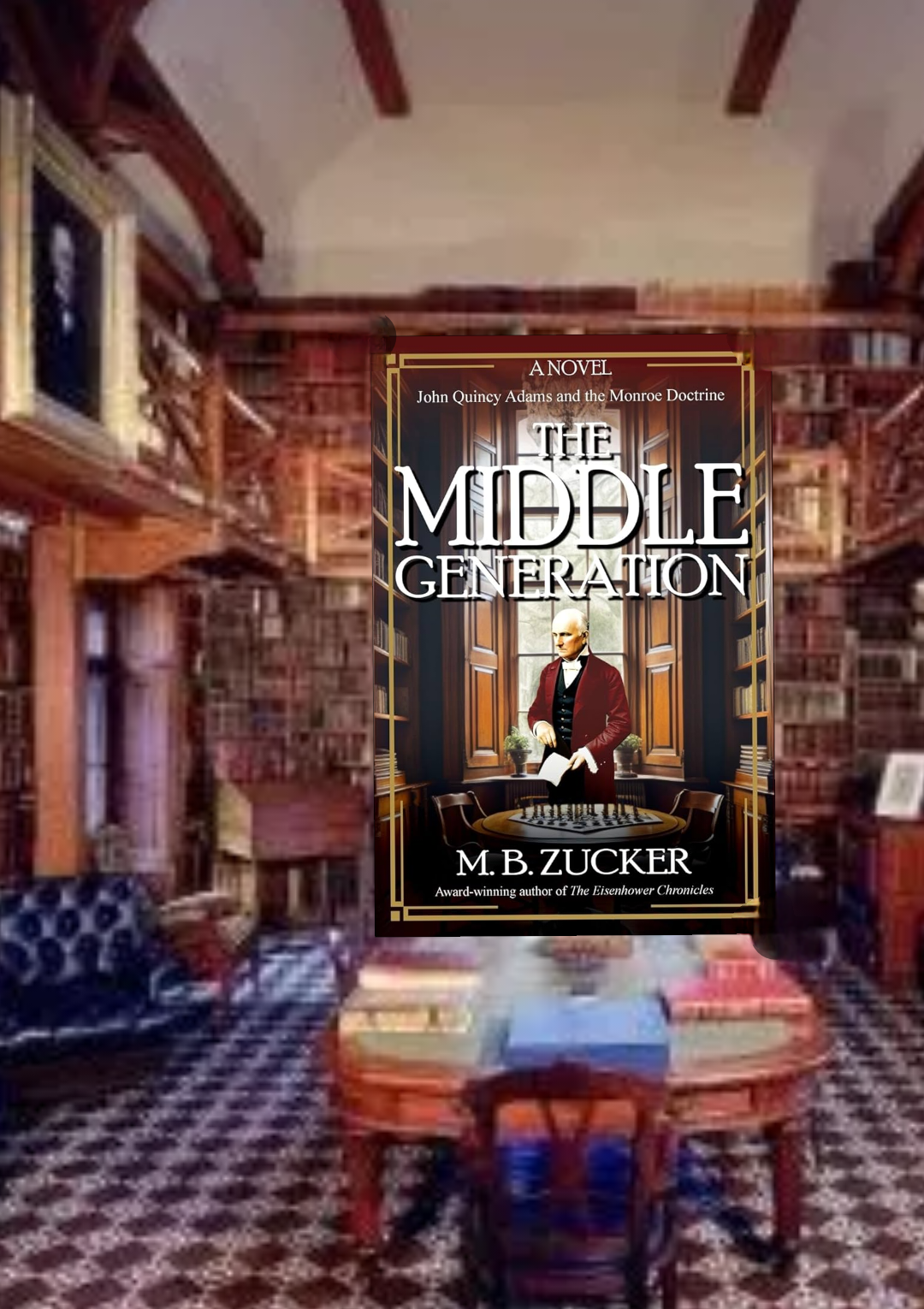
The Middle Generation:  A Novel of John Quincy Adams and the Monroe Doctrine.  M.B. Zucker.  Historium Press, 2023.  507 pages.  


When I first heard of The Middle Generation, my interest was immediately piqued.  Historical fiction about John Quincy Adams, probably the most intellectual president ever and one of the most accomplished American figures in history who is unfortunately often placed on lists of worst presidents ever, set during one of the most critical time periods in American history?  And it was implied that the book was something of a political thriller, well researched by the author who based it on Adams' personal journals and letters.  What a unique idea!  

John Quincy Adams himself represents a major transition between the classical revolutionary America and the America that became a world player.  He was groomed for greatness from childhood b his father and revolutionary leader John Adams, acting as his personal secretary by his early teens, bridging generations of American political leaders. He was the first President to wear long trousers instead of knee britches.  He was a staunch opponent of slavery and an advocate of industrializing and diversifying the national economy.  He envisioned the United States as an equal to the European powers, ready for a seat at the table.  

Like his father, though, he was never a politician,  and he never had the personality for it.  He was blunt, direct, and found social situations and everyday small talk tedious and pointless.  In short (pun, get it?), like his father, he was "obnoxious and disliked."  Quincy comes off poorly in this book, cold and distant, a terrible father and husband.  His constant struggle is to live up to his parents' expectations for greatness and legacy. His wife is portrayed as perpetually miserable, grieving the loss of a child, dealing with Adams' distance, and always overshadowed by her mother-in-law who was a very strong woman and equal partner to husband, yet Quincy never seemed to see Louisa as a real partner.  Their children come across as spoiled, entitled, whiny brattish losers who constantly disappointed their parents and grandparents.

Alas, the book is not a political thriller. Instead, it focuses on Adams' service as Monroe's Secretary of State and his role in securing US borders with Canada, acquiring Florida, and negotiating the Missouri Compromise and the Monroe Doctrine.  It's kind of like a "West Wing" 1820, mostly debates and discussions  with and amongst the President's cabinet, Speaker of the House (and presidential rival) Henry Clay, and various foreign ambassadors.  It's interesting if you're a political wonk, but political thriller it definitely is not.


A review


Atomic Werewolves and Man-Eating Plants:  When Men's Adventure Magazines Got Weird  (Men's Adventure Library).  Robert Deis and Wyatt Doyle, editors.  New Texture, 2023.  328 pages

Men's Adventure Magazines were a popular genre of magazines from the late 1940s into the 1970s.  Each issue was an anthology of adventure stories, crime tales, and science fiction deliberately targeted at young men seeking an escape from their daily lives. While there were a few true stories, most of the stories were fiction, often very sensationalistic, sexy, thrilling, and violent, often set on battlefields, in jungles, or faraway planets.  By today's standards, the tales are in no way politically correct or "woke."  They very much reflect the time period in which they were published, and many wouldn't be published today.  Although some of the authors never really achieved much fame aside from the magazines, many famous authors contributed stories as well, and the illustrations on the covers and in the stories, created by the leading graphic artists of the day, are every bit as amazing as the stories.

Co-editors Robert Deis and Wyatt Doyle began collecting these stories and publishing special editions under the name "Men's Adventure Library."  This collection has everything for lovers of fantasy adventure: werewolves, dinosaurs, mad scientists, supernatural, vampires, killer robots, cryptids, and more.  I enjoy the collections for the stories and the illustrations themselves but also for both the historical subtext and context, providing windows into another time.  


A Splendid Savage:  The Restless Life of Frederick Russell Burnham.  Steve Kemper.  W.W. Norton & Company, 2016.  448 pages.  

Frederick Russell Burnham was one of the best known American men of the late 19th and early 20th centuries.  He was a celebrity whose exploits were breathlessly reported by the press throughout North America, Africa, and Europe.  He was friends with, and admired by,  Buffalo Bill Cody, Theodore Roosevelt, Winston Churchill, Cecil Rhodes,  adventure author H. Rider Haggard, Robert Baden-Powell, and some of the wealthiest men in the world with names like Hammond, Whitney, and Guggenheim, just to name a few.  He was known as the greatest military scout in the world, typically known by the phrase "The American Scout," having served in the Apache Wars, the Ndebele and Shona Wars in South Africa and Rhodesia (now Zimbabwe), the Boer War, and the Yaqui War in northern Mexico in the early 1900s.  He amassed huge fortunes for himself, and others, in gold, land, and stocks and then lost them, always in search of the next big bonanza and always having to start over.  Lord Baden-Powell was inspired to create the Boy Scouts by Burnham, even adopting Burnham's preferred hat and kerchief uniform as the official Boy Scout uniform; without Burnham, there may never have been a Boy Scouts organization.  In his amazing life, Burnham acquired stories that enthralled the world.  It was said of Burnham that he was the only man alive who could tell true adventure stories that made Theodore Roosevelt shut up and listen.

And yet, you, like me, have probably never heard of him.  I was definitely intrigued when I saw this as an earlier book written by Steve Kemper, the author of Our Man in Tokyo which I enjoyed reading, so I had to read it as well. It is definitely an incredible story about an incredible life, but why is he forgotten now?  Well, he is, as they say, problematic.  He espoused socialist ideas, but he lived his entire life constantly searching for his next big fortune.  He was definitely a white supremacist, and he flirted with the ideas of eugenics.  He was a major big game sport hunter, but he became a leading conservationist, very influential in the creation of many national and California state parks and forests.  He was never able to sit still for long, always leaving his wife and family for long stretches to go to war or on expeditions.  If given the option, he was always pro-war and pro-conquest, constantly decrying the softness and decline of America and Americans.  He was definitely an imperialist.  He believed that "real men" should always take risks and be willing to die for it.  In other words, he was a multifaceted, complicated man that defies simplistic categorization --- you know, human.


The Story of the Sarasota Assassination Society.  Tony Dunbar.  Blind Pass Publications LLC, 2022. 248 pages.  Book 1 of 3 in Florida Fables series.

During Reconstruction and throughout the late 1800s, the South was roiled by economic and political division and turmoil, and violence and lawlessness often occurred.  Hollywood and the American imagination have always romanticized and focused on the Old West during this time, but there's no need to travel that far to taste the wild frontier.  Florida was every bit as wild, rugged, violent, and dangerous as Tombstone and Deadwood, with alligators, hurricanes, and swamps thrown in.  There were new lands to be claimed, fortunes to be made, and lots of opportunities for people to invent new lives or simply to hide from their old ones.

Author Tony Dunbar has written a three volume series of historical fiction novels focused on the McFarland family of southwest Florida, in and around Sarasota and based on real people and events.  Today, people think of Sarasota as a sleepy beach town, populated by old people with rich and famous people living in extremely expensive beach communities, but, in the 1880s, it was a very small fishing community surrounded by dirt poor farmers and ranchers trying to scratch out a living.  Still, politics and division invaded, along with greedy developers from the north, and turned residents against each other.  The Sarasota Assassination Society was formed, with members calling it a "political association."  Members swore oaths of secrecy, loyalty, and obedience, complete with secret handshakes and identifying signs, in order to protect their vision of Florida.  The result was murder.  Young deputy Gawain McFarland is thrown into the middle of the ensuing manhunt for the killers.  It's quite an interesting read and look into historical Florida.


Author Talk

Kill 'Em and Leave:  Searching For James Brown and the American Soul.  James McBride.  Spiegel & Grau, 2016.  256 pages.

In the past few years, author James McBride has published two extremely well-received novels, Deacon King Kong and The Heaven and Earth Grocery Store, but, in 2016, he published Kill 'Em and Leave, a biography, of sorts, of James Brown.  It's biography-ish, but it's also a book about McBride's process and efforts to discover the truth about The Godfather of Soul, and along the way McBride also reveals a bit, and learns a bit, about himself.  It's a difficult process because throughout his life Brown constantly told different stories to different audiences and made a concerted effort to keep almost everyone he ever knew from getting too close to the real James Brown.

In the opening pages, McBride posits that Brown was and is perhaps the most recognized, most famous, and most influential black man to ever live, and he sets out to make his case.  It's a remarkable story. Abandoned by his mother (It's still disputed whether she left or was driven away by his father.), at a very young age, Brown was mostly raised by his father's extended family, several female cousins and aunts.  He dropped out of school and did a three year stretch in a Georgia youth prison, becoming a school janitor after his release and singing in churches and juke joints in Georgia and South Carolina before becoming one of the biggest names in music.  What a life. The spending, the women, the bands, the career.  Quirks on top of quirks.  Brown never went anywhere without thousands in cash and cashiers checks on him. He, like many old-school black performers, having been cheated before, demanded cash payments before taking the stage.  In his Augusta Georgia home, he had a "money room" filled with shoeboxes of $100 bills and wheelbarrows of silver dollars.  He frequently gave cash, jewelry, and cars to friends and associates. The IRS came after him, wiping him out twice.  Each time, he back. When he died in 2006, his tax troubles were resolved, and his estate was estimated at $100 to 150 million.  

In spite of all the tragedies and hardships Brown experienced (in some cases, caused) in his life, the biggest tragedy may have been what happened after his death.  Brown's will left everything but personal belongings, about $100 million, earmarked to create an educational foundation for poor Georgia and South Carolina children. To date, none of that money has been used for that purpose.  Instead, it has gone to lawyers hired by Brown's various children and wives to fight the will, and the fortune fell to $2-4 million.  In 2021, a resolution of sorts was finally reached, maybe, but legal battles continue, and Brown's wishes haven't been met.

This was a great read.  I really enjoyed it.
 

Thursday, November 30, 2023

Shelved: Roundup of Book Posts November 16 - 30, 2023


Author talk

All the Sinners Bleed.  S A Crosby.  Flatiron Books, 2023.  352 pages.

"Mystery/Thriller/Suspense" is not a usual genre for me to read, but I've read great things about author S.A. Crosby, and he is one of the guest authors at February's Savannah Book Festival, so I decided to give his latest a try.  It ended up being a good read. The "Mystery/Thriller/Suspense" part is a pretty good thriller that definitely kept me engaged, but there's more to Crosby's books.  He's gotten a lot of attention because he's very good at writing thrillers through the southern history lens.  His books incorporate all the southern threads:  race, class, poverty, religion, change, and resistance to change.  

All the Sinners Bleed's main character is Sheriff Titus Crown, former FBI agent and the first black sheriff in a rural Virginia county.  He has a lot to deal with. Memories of his last major FBI case, which left him mentally and physically damaged, affect every aspect of his personal and professional life as he steps into his new role as Sheriff of the county he was born and raised in.  He knows the people, their stories, and their attitudes.  A year into his tenure, a serial killer emerges, and it becomes Titus' job to stop him.  History is a major part of the story, the characters' histories, the community history, and southern history in general.

Great quote from the book:  "It occurred to him that no place was confused about its past or more terrified of the future than the South."  


James Garner on The Tonight Show

The Garner Files.  James Garner and Jon Winokur.  Simon & Schuster, 2011. 288 pages.  

James Garner may be the most beloved man in the history of the entertainment industry.  No one has ever had a bad word to say about him, and co-stars, crewmembers, and friends speak in glowing terms. Men love his common sense, humble, smart, and funny on -screen characters, and women love his tall, dark, handsome, sensitive, and humorous side. As the saying goes, women want to be with him, and men want to be him or at least be buddies with him.

I'm no exception.  "Maverick" is my all-time favorite western tv show and character, and I still watch often.  I watched "The Rockford Files" as a kid and still watch occasionally.  I discovered his autobiography from a social media reel that quoted from it.  The man was everything you would expect.  James Bumgarner grew up in Depression-era Oklahoma, and he had a really hard life with an alcoholic father and an abusive step-mother.  He got into acting because he didn't want to be a carpet-layer, and he carved out a fantastic career.  The whole book is a great read, and my impressions of Garner are confirmed.  He does seem to really have been a great guy.  OK, he did have one major defect:  even the scent of garlic or onions made him physically ill, but I can overlook that.

Garner, Maverick, and Rockford fans will really enjoy the book with all of its behind the scenes stories.  Garner created two of the most unique, interesting, and beloved characters in television history.  "Maverick" and "The Rockford Files" are both genre-benders that have endured for decades.  Throughout his career, Garner hated all of the trappings of Hollywood stardom, the awards, the pretensions, the publicity, and the business aspects.  He simply saw acting as a job (better than laying carpet), and he did his best at it.  Along the way, he treated co-stars, crew members, and fans respectfully and became one of the most admired and universally loved people in entertainment history.


CBS Sunday morning segment 


Thank You (Falettin Me Be Mice Self Agin): A Memoir.  AUWA, 2023.  320 pages.  

I have always been aware of Sly and the Family Stone. Peripherally, growing up in the 70s and 80s. Mostly country music was played in our house, and my older brother was listening to rock, especially southern rock, but I heard Sly Stone music and caught variety and talk show appearances here and there.  Then, he seemingly disappeared.  I discovered funk as a teen and saw huge connections between Sly Stone and Prince, Rick James, George Clinton, and The Time, so I went back and dug slightly deeper into Family Stone music, still didn't know much beyond the hits.

As Sly and the Family Stone climbed the charts, Stone, aka Sylvester Stewart, fell into the trap of drug addiction and developed an unprofessional reputation of no-shows, tardiness, abbreviated and bad performances, incoherent interviews, tantrums, excess, and even gunplay.  As a result, he disappeared from the music industry. (Actually, he still worked, sometimes in front of very small audiences.) Thankfully, he's now in a period of sobriety, at age 80, and he tells his own story in this just published autobiography.  In spite of his struggles with drug use, the story is clearly and thoughtfully told.  I'm amazed by his memory.  His genius also shines through as it becomes clear that he became a real student of music and music theory at an early age, and he was calculating and methodical about so much of his career, not just the music itself, but also how he put the band together, how he dealt with record company executives, and how he managed the band,  He created a new kind of music and brought people together during a very divisive period, creating iconic and unique songs that have stood the test of time, and he was a major influence on many performers since, but he wasn't always the best human being. It's great that he is still around to tell his story and perhaps still be recognized during his lifetime.  Most people around him in the 1970s probably never imagined that would have been possible.


Interview in two parts (audio)

An Edible History of Humanity.  Tom Standage.  Bloomsbury USA, 2010.  288 pages.

In 2005, Tom Standage published A History of the World in 6 Glasses, telling history through the histories of 6 of the most common drinks in the world, including coffee, tea, beer, and Coke. It became one of my favorite  reads. In 2010, he published An Edible History of Humanity, a more general look at world history.

"More than simply sustenance, food historically has been a kind of technology, changing the course of human progress by helping to build empires, promote industrialization, and decide the outcomes of wars. Tom Standage draws on archaeology, anthropology, and economics to reveal how food has helped shape and transform societies around the world, from the emergence of farming in China by 7500 b.c. to the use of sugar cane and corn to make ethanol today. An Edible History of Humanity is a fully satisfying account of human history." (publisher's blurb)

The result is a really engrossing new perspective on history, but it's not quite as engrossing, in my opinion, as Six Glasses. It reads a little drier --- no pun intended -- and at times is a little dense in science. As the title implies, it's  not as much about specific foods as about the impact of certain foods, like grains, sugar, and spices, and the use of food by governments to drive economies, force change, and even to wage war. 


Author interview

Black Death at the Golden Gate:  The Race to Save America From the Bubonic Plague.  David K. Randall.  W.W. Norton & Company, 2019.  304 pages.  (American Experience documentary here https://www.pbs.org/wgbh/americanexperience/films/plague-golden-gate/ )

A deadly epidemic, originating in Asia, threatens  the US.  Politicians, the press, and scientists are divided and at odds with each other on how to deal with the threat.  Various jurisdictions discuss and implement quarantines and start requiring health documents for travel.  At-risk people are isolated. Large portions of the population lose faith in the government and the healthcare system. Many refuse vaccinations. 

No, not 2020 and the pandemic. All of this took place in California in the first decade of the 20th century. In 1900, the first cases of bubonic plague, black death, occurred in San Francisco's  Chinatown. Eventually, there are over 100 confirmed deaths, and probably many, many more hidden from authorities. While one bacteriologist, one of the first in America,  recognizes the grave threat and fights it, politicians, the press, the US Surgeon General ( his boss), Chinese business and tong leaders, and President  McKinley all actively conspire to deny the plague's existence and to destroy the career  of the one man who knows what's  going on.

This book, published in 2019, very much reads like an Erik Larsen or David Grann work- in other words, first-rate. ... And if you're  that rare bird that has any remaining trust in politicians, journalists, or humanity in general, be prepared to lose some of it.