Showing posts with label #fiction. Show all posts

Wednesday, April 6, 2016

Try Some Graphic Novels with a History Theme

By Margaret Duncan, Ed.D.

I fully admit I am an adult that still gets excited to go into a comic book shop.  I am also a parent who has used children’s books, comics, as well as graphic novels to introduce reading to my girls. So, I have also combined all three to try to get them to love History as much as I do.  Periodically, I have also used graphic novels to spark a love of history in my students.  For my girls, they will devour volumes of Manga in one sitting.  So, I am happy when they will devour a graphic novel I recommend to them, sometimes not realizing it was full of history and they actually liked it!

There are a plethora of really good graphic novels that cover a variety of historic topics and time periods.  These are just a sampling of my favorites.

The United States Constitution: A Graphic Adaptation by Jonathan Hennessey takes one of our founding documents—The Constitution and puts it into graphic form.  As a teacher, I enjoy the graphic novel because it takes something students seem to feel is ancient and breaks it down through explanation and illustration.  The novel also does a good job explaining the historical context for when the Constitution is written. 

Harlem Hellfighters by Max Brooks is a fictionalized account of the segregated, all African-American 369th Infantry.  The unit is real but the novel is a fictionalized account of their action in World War I.  The name, Harlem Hellfighters was given to the unit by the Germans they were fighting.  The novel can be brutal and bloody, but so is war.  I first introduced the novel to my National History Honors Society members and quickly realized that they were finishing the book within a day and passing it on to friends to read.  Students who went out of their way to read a novel not assigned, showed me that it was definitely worth incorporating into my class. 

Maus I & II by Art Spiegelman is the story of Vladek Speigelman, a Jewish survivor of the Holocaust.  I first read Maus when I was in college in a World History course.  It was my first introduction to a graphic novel that could teach me about history.  Reading Maus showed me that history could be as real and informative in a graphic novel as well as the traditional novel.  As a World History teacher, I always used Maus in my class.  When my girls were old enough, it was a must read for them.  The novel illustrates the Holocaust by using a cartoon approach.  The Nazis are cats, while the Jews are the mice.

March by John Lewis is a memoir of the Georgia Congressman’s life from his Civil Rights activism to President Obama’s inauguration.  As a native of Atlanta, I have known of Congressman Lewis story since I can remember.  The novel shows the violence of the police crackdown on the 1965 Selma-Montgomery March.  This is a wonderful novel that covers a narrative that is not always in historic novels.

Marvel 1602 by Neil Gaiman is one of my absolute favorite graphic novels.  However, it is not overtly historic but does contain all my favorite Marvel Superheroes.  The novel takes place in the Elizabethan period. Nick Fury and Doctor Strange are advisors to Queen Elizabeth. Charles Xavier is in charge of mutants known as the witchbreed. The familiarity of superheroes in one of my favorite time periods is one of the reasons that this is a wonderful graphic novel.  Throw in the evil King James of Scotland and this is a must read. 

These are just a few of my favorite graphic novels.  What graphic novels based in history would you like to read or recommend?


Thursday, November 6, 2014

Four Daughters

By Jeff Burns

There seems to be a whole sub-genre of historical fiction out there that tells stories from the point of view of daughters, characters who can be both observers and participants in the action and historical events around them.  Here are some recommend options if you’d like to explore.

German author Oliver Potszch has written a series of novels that follow a Bavarian family in the 17th century, starting with The Hangman’s Daughter.  He embarked on writing the series after discovering that his own family, the Kuisls,  were renowned Bavarian executions.  Not only was execution a family business passed down from generation to generation, but the job involved much more than simply execution.  Executioners and their families were an ostracized, but important, element of society at the time.  They not only carried out executions, but many other punishments in those days when prison was not an option, and criminal offenders were tortured, flogged, and mutilated.  As part of their profession, executioners also were practiced in the art of healing and even a little alchemy.  The titular hangman is a veteran of the Thirty Years War that devastated the German states and has his own demons as a result.  He and his daughter, meanwhile find themselves involved in a series of murders that cause them to run afoul of civic and church officials.  While the hangman is the main character, his headstrong and challenging daughter always takes an active role in the investigations.  The books are exciting, fun to read mysteries, and their packed with historic detail.  I love the fact that the author always includes thorough notes in which he talks about the actual locations, events and people that inspired his work.  Subsequent titles include:  The Dark Monk, The Poisoned Pilgrim, and The Beggar King.

Linda Lafferty writes another 17th century tale, this time set in Bohemia, called The Bloodletter’s Daughter.  The title character also comes from a station in life deemed necessary but unseemly, and relegated to the lowest ranks of society.  Her father is not only the town bloodletter, the closest most people got to a trained physician in those days, but he also operated the town bathhouse.  Marketa, the daughter, finds herself the object of the deranged passion of a Hapsburg prince.  Another great murder mystery and thriller based on real life royal figures and a scandal that nearly toppled the dynasty.

From American history, there’s The Heretic’s Daughter by Kathleen Kent.  It is the story of the Salem Witch Trials, told from the point of view of sarah, the daughter of Martha Carrier, one of the first women to be accused and executed for witchcraft.  Kent herself is a 10th generation descendent of Martha Carrier.  It’s a detailed and complex tale of Puritan New England and the of the hysteria that accompanied the trials that led to hundreds of people being jailed and twenty being executed .  There’s one error in the book that got me, Giles Corey, the man pressed to death for refusing to confess, is called Miles, at least in the Kindle edition of the book. 

Moving into the nonfiction realm, there’s Galileo’s Daughter, by  Dava Sobel.  Ostensibly, a biography of Galileo’ daughter, whom he sequestered in  a cloistered nunnery , the book is really a great biography of Galileo, called by Albert Einstein the “father of modern science.”  Sister Maria Celeste’s life, and that of her father, is presented through 124 letters written to her father, in which they touch on a multitude of subjects, including the cloistered life, the Black Death,  his experiments, and of course his persecution by the Catholic Church for heresy. 

Friday, August 29, 2014

Reading about the Great War

By Jeff Burns

June 28, 2014 marked the centennial of the assassination of Austrian Archduke Franz Ferdinand, the event that started World War I. Over the next month or so, the greater and lesser powers of Europe found themselves dragged into what was known at the time as the Great War, or optimistically the War to End All Wars.  Eventually the United States too was dragged in.  Much is being written about the legacies of the war.  In the short term, a generation of Europeans was lost through death, injury, and displacement and the effects of the war and peace that followed would of course lead directly to World War II a quarter century later.  The spirit of nationalism that was one of the causes of the war led to colonial independence movements throughout Africa and Asia.  Even now, we see the geopolitical effects of the war.  Here are just a few books I recommend on the subject.

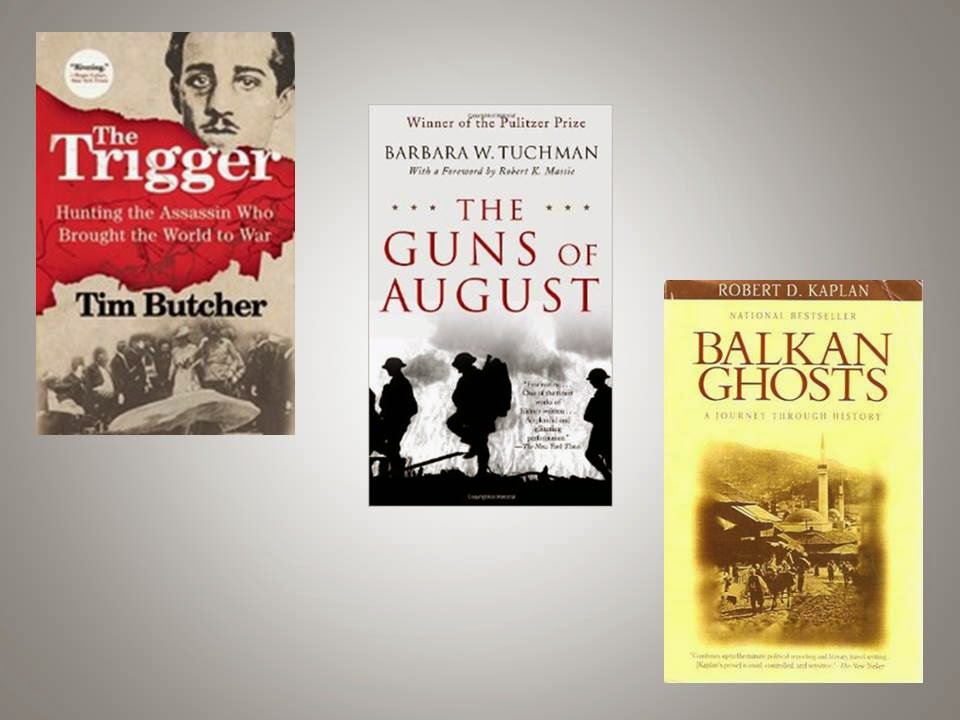
            Journalist Tim Butcher’s new book, The Trigger:  Hunting the Assassin Who Brought the World to War traces the life of Gavril Princip, the nineteen year old who assassinated the Archduke.  I wrote about Butcher’s last book, Blood River, his book following Stanley’s expedition on the Congo River to find Livingstone in an earlier blog. The Trigger  follows a similar template.  Butcher travels to rural Bosnia to begin the story of Princip, a boy from a poor subsistence farming family  whose descendants still live in the tiny village, much as they have for generations and follows his path from there to Sarajevo, then Belgrade, then back to Sarajevo for the fateful act.  Butcher is a great storyteller and a consummate old-school journalist, and it comes through in his work.  First, he immerses himself in research and then he talks to people and faithfully tells their stories.  However, the book is not just about the assassination.  Butcher himself was a war correspondent who covered the Balkans in the 1990s.  He manages to weave the story of the assassination into the intricate fabric of the Balkans, a region shaped by hundreds of years of conflict.  It’s a fascinating read.

Robert Kaplan’s Balkan Ghosts: A Journey Through History is a great book if you’re looking for a more thorough history of the Balkans and the ethnic and religious conflicts that culminated in the wars and genocides of the 1990s.
 
 
 If you’re looking for the classic history of the war, the must-read is Barbara Tuchman’s  The Guns of August.  Tuchman re-creates the first month of the war, and all the steps and machinations leading to the conflict.  This was required reading for a college history course for me, but it was not a chore.  Tuchman is an excellent writer who told an exciting, suspenseful story that happened to be true.
Personally, I’m not a huge military history buff, so my interest in war history is mostly interest in causes and effects.  Another classic about the causes of the war is Dreadnought by Robert K. Massie.  Dreadnought is specifically about the naval arms race between Britain and Germany, part of the militaristic fervor that propelled Europe into war, but the book is not a dry naval  history – pun intended.  When I read this book, I learned so much about the European military leaders and royals whose drive to achieve military superiority, in this case by building the greatest battleship, was a major factor leading to the war.
 
           Turning to fiction, I have a couple of recommendations.  All Quiet on the Western Front is one of the greatest war novels ever written.  In fact it is very much an anti-war novel written by German war veteran Erich Maria Remarque.  The reader experiences the build up to the war, the horrors of the war itself, and their effect on the men involved, through the eyes of its protagonist, Paul Baumer and his comrades.   The book was unique for its time, not a jingoistic, super-patriotic glorification of war, but a realistic portrayal.  In fact, it was one of the first books banned in Nazi Germany because of its anti-war message.  It’s one of my favorite classic novels.
            In an earlier blog, I wrote about Ken Follett’s historic epics, The Pillars of the Earth and World Without End about medieval England and the Century Trilogy.  Book One of the Century Trilogy is The Fall of Giants,  and it follows five families (British, German, Russian, and American as they experience the war , the Russian Revolution, and the British women’s suffrage movement.  And when I say epic, I mean epic.  It’s a huge book, but I was thoroughly engaged from the beginning and finished it very quickly.  As one would expect from Follett, it’s full of historical detail, and is an education in itself about the effects of the war on all segments of society.