Showing posts with label #nonfiction. Show all posts

Wednesday, October 21, 2015

Fall Into a Great New Book

By Jeff Burns

My “to-read” list is getting longer and longer.  Sometimes I think it’s too bad that I have to teach for a living; work is getting in the way of the important stuff:  reading.  This fall, there are number of great books about history being released, and I think my list is only going to get longer.  You might also want to be on the lookout for these titles.

The Last of the President’s Men by Bob Woodward is the heretofore untold story of Alexander Butterfield, a top Nixon aide at the heart of the Watergate Scandal.  It promises more shocking details of the goings on within the Nixon administration.


One of my favorite authors, Sarah Vowell, is releasing a new book called Lafayette in the Somewhat United States.  Vowell is an essayist, humorist, and keen observer of life whose previous books have combined history with current events, always in a funny, engaging, and challenging way.  This book is about the Marquis de Lafayette and his relationships with George Washington and the fledgling United States.

War of Two is about the infamous rivalry between Alexander Hamilton and Aaron Burr, a rivalry that led to the most famous, and most tragic, duel in American history.


Bill O’Reilly is following up Killing Kennedy, Killing Lincoln, and Killing Jesus with Killing Reagan, a biography of Reagan through the prism of the assassination attempt made early in his presidency.


Paul Theroux is one of the most famous travel writers working today, and Deep South is his take on the region.

While on the subject of the South, Rick Bragg has published a new collection of essays, never before published.


Finally, three music icons (and three of my favorites) have published autobiographies.  Each one is said to be an unflinching and honest account.


These are just a few.  Are there any new books about history that are on your list?

Sunday, October 11, 2015

History Books and Historical Fiction for Kids

By Nina Kendall

Are you a reader? Do you want to share your love of reading and history with your young reader? Are you looking for a good place to start? History books for children and historical fiction for children offer some great options for inspiring young readers.

The love of history and reading grew together in my house. I grew up reading about history and visiting historical sites. History and books inspired conversations and trips. I have fond memories of Johnny Tremaine, The Witch on Blackbird Pond, and Little House on the Prairie. I could share in their experiences and adventures.  

As a teacher and a parent I have had the chance to share the love of reading about history and visiting historical sites with a new generation. From the Magic Tree House series to Bud not Buddy; I have continued to share books about history written for young readers.

Today we all benefit from the growth of books being published. Books published about history or with historical themes continue to grow.  If you are looking for a history book to share with your young reader, check out our list of old and new favorites.  It would be a great way to share your love of history with a new generation. You both may find a history book to love.


Do  have a suggestion to share? Let us know in the comments or send us a pin on Pinterest. We are always on the lookout for a good book.

Tuesday, September 9, 2014

Band of Giants, The Amateur Soldiers Who Won America's Independence

By Nina Kendall
The American mythos is marked with celebration of the great acts of ordinary individuals. The leaders of the American Revolution are often portrayed as heroic figures fighting together in the name of liberty. Band of Giants, The Amateur Soldiers Who Won America's Independence by Jack Kelly is a fast paced account of early American leaders from the French and Indian War to the Treaty of Paris, 1783. Kelly uses a unique blend of personal accounts and military strategy to engage the reader and reveal the lives of military leaders in the late 18th century. If the American Revolution serves as the origin story for America’s early leaders, Jack Kelly is going to introduce them to you in a whole new way.

Band of Giants offers the reader as chance to follow the Continental Army into battle.  You can march with Benedict Arnold into Canada and learn about Knox’s rescue of cannon for the Colonists. This book is a chance to get inside the head of America’s first military leaders. Kelly helps you get to know the leaders of American forces and their challenges as he mixes military maneuvers with excerpts from correspondence. What led Henry Knox and Nathaniel Greene to choose to go to war?  How did untested soldiers learn the practice of war?

What did George Washington know of war? In Band of Giants, you can come to know George Washington as a general. Learn of his early experience in the Ohio territory. How did he emerge as a leader in the Revolution? With careful research, Kelly reveals Washington’s growth as a leader and internal struggle during the war. Jack Kelly illustrates the relationships Washington has with key figures in the American Revolution that shape the course of the war. The strife with Charles Lee and the betrayal of Benedict Arnold strain Washington’s reserves. Yet, he draws strength from the support of the Marquis de Lafayette.

Jack Kelly gives the reader insight into to circumstances that influenced many of America’s military leaders.  Military leaders whose names dot the American landscape like Lafayette, DeKalb, and Greene emerge from the page as historical figures. Carefully woven prose makes clear the vital support America received from abroad and the risk is commanders faced on the front.  Who helped the Continental Army? What risks did they take? Delve into the mind of the young Marquis de Lafayette who risks his life and wealth in support of liberty during the American Revolution. Kelly clearly connects the contributions of men like Baron von Steuben to the success of the Continental Army.

Take the opportunity to read Band of Giants and dig into the lives of ordinary men who helped fight for American independence.  See leaders of the American Revolution as you never have before.

Friday, August 29, 2014

Reading about the Great War

By Jeff Burns

June 28, 2014 marked the centennial of the assassination of Austrian Archduke Franz Ferdinand, the event that started World War I. Over the next month or so, the greater and lesser powers of Europe found themselves dragged into what was known at the time as the Great War, or optimistically the War to End All Wars.  Eventually the United States too was dragged in.  Much is being written about the legacies of the war.  In the short term, a generation of Europeans was lost through death, injury, and displacement and the effects of the war and peace that followed would of course lead directly to World War II a quarter century later.  The spirit of nationalism that was one of the causes of the war led to colonial independence movements throughout Africa and Asia.  Even now, we see the geopolitical effects of the war.  Here are just a few books I recommend on the subject.

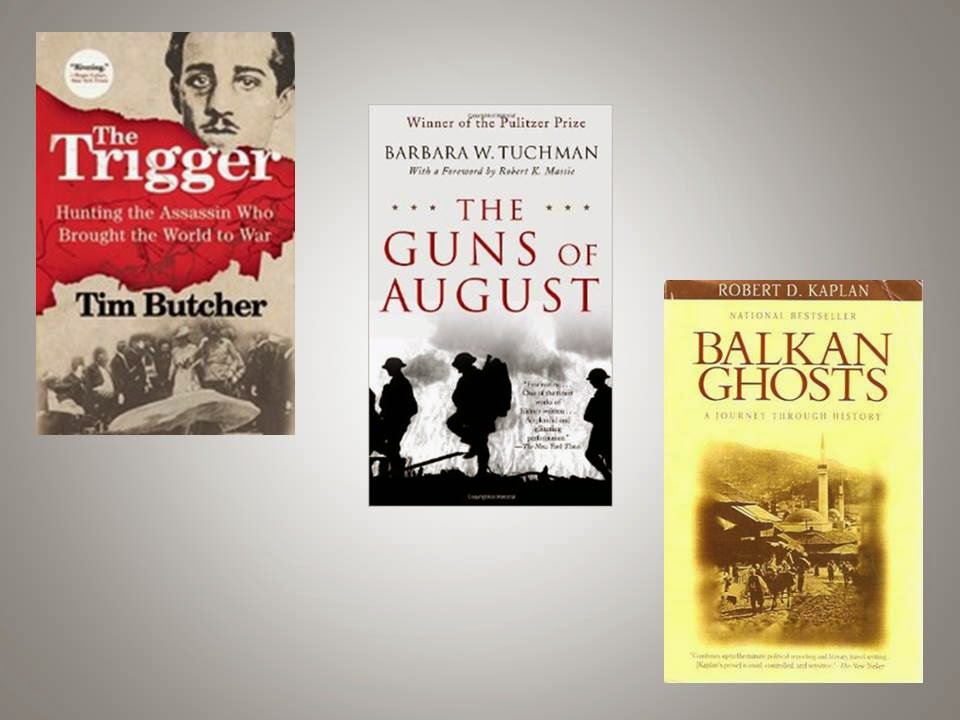
            Journalist Tim Butcher’s new book, The Trigger:  Hunting the Assassin Who Brought the World to War traces the life of Gavril Princip, the nineteen year old who assassinated the Archduke.  I wrote about Butcher’s last book, Blood River, his book following Stanley’s expedition on the Congo River to find Livingstone in an earlier blog. The Trigger  follows a similar template.  Butcher travels to rural Bosnia to begin the story of Princip, a boy from a poor subsistence farming family  whose descendants still live in the tiny village, much as they have for generations and follows his path from there to Sarajevo, then Belgrade, then back to Sarajevo for the fateful act.  Butcher is a great storyteller and a consummate old-school journalist, and it comes through in his work.  First, he immerses himself in research and then he talks to people and faithfully tells their stories.  However, the book is not just about the assassination.  Butcher himself was a war correspondent who covered the Balkans in the 1990s.  He manages to weave the story of the assassination into the intricate fabric of the Balkans, a region shaped by hundreds of years of conflict.  It’s a fascinating read.

Robert Kaplan’s Balkan Ghosts: A Journey Through History is a great book if you’re looking for a more thorough history of the Balkans and the ethnic and religious conflicts that culminated in the wars and genocides of the 1990s.
 
 
 If you’re looking for the classic history of the war, the must-read is Barbara Tuchman’s  The Guns of August.  Tuchman re-creates the first month of the war, and all the steps and machinations leading to the conflict.  This was required reading for a college history course for me, but it was not a chore.  Tuchman is an excellent writer who told an exciting, suspenseful story that happened to be true.
Personally, I’m not a huge military history buff, so my interest in war history is mostly interest in causes and effects.  Another classic about the causes of the war is Dreadnought by Robert K. Massie.  Dreadnought is specifically about the naval arms race between Britain and Germany, part of the militaristic fervor that propelled Europe into war, but the book is not a dry naval  history – pun intended.  When I read this book, I learned so much about the European military leaders and royals whose drive to achieve military superiority, in this case by building the greatest battleship, was a major factor leading to the war.
 
           Turning to fiction, I have a couple of recommendations.  All Quiet on the Western Front is one of the greatest war novels ever written.  In fact it is very much an anti-war novel written by German war veteran Erich Maria Remarque.  The reader experiences the build up to the war, the horrors of the war itself, and their effect on the men involved, through the eyes of its protagonist, Paul Baumer and his comrades.   The book was unique for its time, not a jingoistic, super-patriotic glorification of war, but a realistic portrayal.  In fact, it was one of the first books banned in Nazi Germany because of its anti-war message.  It’s one of my favorite classic novels.
            In an earlier blog, I wrote about Ken Follett’s historic epics, The Pillars of the Earth and World Without End about medieval England and the Century Trilogy.  Book One of the Century Trilogy is The Fall of Giants,  and it follows five families (British, German, Russian, and American as they experience the war , the Russian Revolution, and the British women’s suffrage movement.  And when I say epic, I mean epic.  It’s a huge book, but I was thoroughly engaged from the beginning and finished it very quickly.  As one would expect from Follett, it’s full of historical detail, and is an education in itself about the effects of the war on all segments of society.


Friday, March 21, 2014

Listening to History: Audio Books

By Jeff Burns

I have a very short commute, thankfully, only 5-10 minutes one way.  Nevertheless, I’ve developed the habit of keeping some audio book or course in my car stereo.   So whenever I’m in my car, I have the option of learning some history. 

There are a number of great podcasts available, and that might be a future blog topic.  However, I want to talk about two great sources of audio lectures.  You’re sure to find something of interest in these collections.

First up is the Portable Professor series from Barnes and Noble.  These are full courses taught by well-known authors and historians.  Each package consists of 14 35-minute lectures and includes a guidebook.   I own Masters of Enterprise:  How the Titans of American Business Shaped the US Economy by H.W. Brands, To Lead A Nation: The Presidency in the 20th Century by Robert Dallek, Shaping justice:  Landmark cases of the US Supreme Court by Kermit Hall, and Everything You’ve Been Taught Is Wrong:  Fact, Fiction, and Lies in American History by James W. Loewen.  Each one is engaging, challenging, and insightful. 

They’re relatively inexpensive, especially if, like me, you find them  in the clearance section of the Barnes and Noble Store.  You can also find them on the Barnes and Noble website, ebay, libraries, and used book stores.


Another great source is The Great Courses.  They record first rate lectures on just about any subject imaginable by some of the greatest university lecturers and package them thorough outlines or guidebooks to follow along.  So far, I’ve enjoyed The Skeptic’s Guide to American History by Mark Stoler, Books That Have Made History by J. Rufus Fears, and The American Identity by Patrick Allitt.  They’ve all been terrific.  The individual lectures a bit longer than Portable Professor, 45-50 minutes each, but each lecture is extremely interesting.

While the full retail price on the website can be pretty high, the Great Courses Company often runs sales and has special offers.  I purchased mine through ebay, and again, you can find them in libraries and second hand markets for a more affordable price.

Jump right in and listen to history as you drive, work out, craft, or whatever. 

Tuesday, March 4, 2014

Drink in the History

By Jeff Burns

Food is such an important and distinctive part of world history and cultures that it should be no surprise that many books have been written on the subject of food history.  From time to time to time, I’ll discuss a few that you may be interested in reading for yourself.  This first installment will be about beverages that have shaped history...

 
One of my favorites in this category is A History of the World in 6 Glasses by Tom Standage.  Standage delivers just what the title promises, and it becomes a very unique way of looking at world history.  Instead of Bronze age, Stone Age, or Iron Age, he describes the ages of beer, wine, spirits, coffee, tea, and cola.  Each beverage ushered in a major phase of human history.  For example, the development of beer parallels the development of agriculture, cities, and laws, and the development of Coca-Cola marked the beginning of modern globalization.  For Tom Standage, each drink is a kind of technology, a catalyst for advancing culture by which he demonstrates the intricate interplay of different civilizations. You may never look at your favorite drink the same way again.
Craze: Gin and Debauchery in an Age of Reason by Jennifer Warner traces the effects of gin, “the original urban drug,” on the city of London, following its introduction around 1720.  Gin quickly became associated with squalor, depression, criminality, and wretchedness.  While the London power fell deeper under the curse of gin, politicians and social commentators like Daniel Defoe, William Hogarth, and Samuel Johnson railed and took action against it, with little impact.
While gin seemed to threaten western civilization in the estimation of many, Stewart Lee Allen posits in The Devil's Cup: A History of the World According to Coffee that it was the discovery of coffee that gave birth to and drives the history of modern western civilization.  Uncommon Grounds: The History of Coffee and How It Transformed Our World by Mark Pendergrast  has a similar theme and is equally interesting.
Pendergrast also wrote For God, Country, and Coca-Cola, the unauthorized history of the great American soft drink and the company that makes it, from its origins as a patent medicine in Reconstruction Atlanta through its rise as the dominant consumer beverage of the American century.
Tea drinker?  Then you might like For All the Tea in China: How England Stole the World's Favorite Drink and Changed History by Sarah Rose.  It is the dramatic story of one of the greatest acts of corporate espionage ever committed. By the middle of the nineteenth century, the British East India Company faced the loss of its monopoly on the fantastically lucrative tea trade with China, forcing it to make the drastic decision of sending Scottish botanist Robert Fortune to steal the crop from deep within China and bring it back to British plantations in India. His dangerous odyssey, recounted here, makes for an exciting read over a cup of tea.
Take your pick, pour a cup, and enjoy!

Saturday, January 18, 2014

Jim Crow, the White House, and Burying a King

By Jeff Burns

            On this Martin Luther King Day weekend, I thought I’d recommend some very interesting books on the civil rights struggle that I’ve read in the last couple of years. 

After the Civil War, some blacks decided that they had to leave the South in order to exercise their newly won freedom.  Many of them moved to Kansas, where they built farms and all-black towns.  They called themselves Exodusters, in an allusion to the biblical Exodus, and Nell Irvin Painter documents their story in Exodusters: Black Migration to Kansas After Reconstruction.

Guest of Honor: Booker T. Washington, Theodore Roosevelt, and the White House Dinner
That Shocked a Nation by Deborah Davis tells the story of a seemingly innocuous event that caused a firestorm of controversy that threatened the administration of Theodore Roosevelt.  In 1901, TR invited Booker T. Washington to have dinner with his family in the White House.  It was the first time a black man had dined in the White House, and the ensuing hysteria almost destroyed both men.  The book does a great job of telling the story of the event and the two men with fascinating insights.

Slavery by Another Name: The Re-Enslavement of Black Americans from the Civil War to World War IIby Douglas Blackmon brings to light the shameful practice used across the South for 100 years after the Civil War.  Black men were routinely arrested and convicted  on a wide range of charges, bogus charges in many cases.  When they were unable to pay their assessed fines or bails, they essentially became slaves of the jurisdiction, forced to work on city and county projects and even rented out to local businesses and farmers.  It’s a painful reminder that slavery did not end with the Civil War.

Do you ever wonder how “soul food” got to places like Chicago, Detroit, and Philadelphia?  After the Civil War, some blacks moved away from the South, but it was not until World War I that there any real numbers.  During World War I (and later in World War II), factories in northern cities desperately needed workers, and thousands of southern blacks moved North to take advantage of the opportunity.  The Warmth of Other Suns: The Epic Story of America's Great Migration by Isabel Wilkerson chronicles this huge demographic trend from 1915 to 1970.  The book reflects her exhaustive research and interviews with over a thousand people, but Wilkerson masterfully tells the story through the lives of three individuals involved.


Whenever I taught the history of the civil rights movement in the past, I always talked briefly about Thurgood Marshall, pretty much just mentioning him as the chief attorney for the NAACP who led the fight to segregate schools in the Brown vs Board of Education case and as the first black Supreme Court justice.  I didn’t really know much more myself.  Then I read Gilbert King’s Devil in the Grove: Thurgood Marshall, the Groveland Boys, and the Dawn of a New America, and I learned much more about what a great America hero and courageous man he really was.  The book is about a horrific miscarriage of justice that occurred in Lake County Florida, the heart of citrus country,  in 1949 when four young black men were accused of raping a white girl.  Marshall organized and led their defense, at great risk to his own life.  As a result of reading the book, my respect for Marshall the man has increased tremendously, and I think he deserves much more recognition than he receives in civil rights history.

When MLK, Jr was assassinated in 1968, violence erupted in over one hundred cities across the country, but peace reigned in Atlanta, his hometown.  Rebecca Burns (no relation) wrote Burial for a King: Martin Luther King Jr.'s Funeral and the Week that Transformed Atlanta and Rocked the Nation about that trying week leading up to King’s funeral as Atlanta coped with overwhelming grief, despair, and tension as Atlanta became the focus of world attention and was saddled with the racist, segregationist Governor Lester Maddox, an active KKK member threatening violence, and the arrival of thousands and thousands of mourners including numerous national political figures and celebrities.  Burns tells the stories of numerous individuals who worked to keep the peace including the Atlanta Mayor Ivan Allen, who was a phenomenal leader during the time. 


Monday, January 6, 2014

The Westerns: Adventure and History in Books

By Jeff Burns

            In the mood for a story about the West?  Let me recommend a few good books that you may not have heard about.

First, the novels:  One Thousand White Women: The Journals of May Dodd and The Wild Girl: The Notebooks of Ned Giles, 1932, both by Jim Fergus.  They are both fictionalized accounts of journals written by very interesting people in unique settings.

            Imagine a secret treaty between the US and the Cheyenne nation in 1875.  The Cheyenne chief demands that, in order to expedite the assimilation of his people into a peaceful coexistence with whites, 1000 white women must be sent west to become wives of Cheyenne warriors.  The government rounds up prostitutes, criminals, and asylum patients, women who wouldn’t be missed by many.  One of the women selected is May Dodd, committed to an asylum by her parents because she has an “unnatural” sexual appetite.  (At the time, “unnatural” meant that a woman enjoyed sex, and some women were medically treated and even institutionalized for the malady.)  May tells her own story and the stories of several other women as they adjust, or not, to Cheyenne life, including a former slave who becomes a great warrior on her own.

            In The Wild Girl, a rancher’s young son is kidnapped by a small renegade band of Apaches.  A large expedition is mounted to rescue him.   Joining a motley crew of millionaire playboys, cowboys, and soldiers in this last great Indian “adventure” is a young photographer named Ned Giles who forms an unusual relationship with the wild girl of the title, a captured member of the Apache band used by the expedition to find the renegades and perhaps to be traded for the boy.
            One of my favorite John Wayne movies is “The Searchers,” in which the Duke is searching for his niece, stolen by the Comanches.  The movie was inspired by and loosely based on the real life story Cynthia Ann Parker, a girl stolen by Comanches.    The Comanches dominated a huge territory in the southern plains, terrorizing Anglos, Mexicans, and other Indians throughout Texas, Oklahoma and northern Mexico for many years.  Cynthia Parker’s son, Quannah Parker, became the most famous Comanche chief, leading at the height of the tribe’s power.  S.C. Gwynne chronicles this history in Empire of the Summer Moon: Quanah Parker and the Rise and Fall of the Comanches, the Most Powerful Indian Tribe in American History.

            After reading Empire, I was led to read The Texas Rangers: Wearing the Cinco Peso, 1821-1900 by Mike Cox. The Texas Rangers were formed chiefly to fight the Comanches before becoming the chief law enforcers of the state.   (Wayne’s character in “The Searchers” is a Ranger.)  It took a particular kind of man to be a Texas Ranger, and Cox tells their story well in this very interesting book.
            We all know about the Trail of Tears, but how much do you know about the Long walk of the Navajo?  Blood and Thunder: The Epic Story of Kit Carson and the Conquest of the American West by Hampton Sides tells the story of Kit Carson’s brutal conquest of the powerful Navajo nation and their forced relocation to a barren reservation.
            If you’ve ever seen any photographs of Indians, you are probably familiar with the work of Edward Curtis, probably the most famous Indian photographer who desperately tried to capture the history of the Native Americans before they all disappeared in the early 20thcentury.  Timothy Egan wrote a fascinating biography of the man and account of his life’s work in Short Nights of the Shadow Catcher: The Epic Life and Immortal Photographs of Edward Curtis.
            Finally, here are two novelists that you can’t go wrong with:  Larry McMurtry, the author of Lonesome Dove, and Tony Hillerman, the author of the series of mysteries featuring Navajo policeman, Joe Leaphorn.

            So, saddle up and head west, Pilgrim!