Showing posts with label #2014. Show all posts

Sunday, December 14, 2014

Coloring Books: Not Just Kids’ Play

By Jeff Burns

I don’t do it often enough  these days, but I do enjoy it, and I plan to get back in the habit.  What habit?  Coloring  I’m generally not very artistic, but I do find myself doodling in meetings, and I like coloring with pencils.  But coloring’s just for kids, right?  Not at all.  A recent article touts the benefits of coloring for adults. Coloring produces, according to the studies cited, wellness and reduces stress, while stimulating creativity, mental activity, fine motor skills and the senses.  Creating coloring books for adults is apparently a trend for publishers around the world.

One company that has been ahead of that curve is Dover Publications.   I’ve been aware of Dover’s great historical coloring books from my first days as a teacher.  Back in the olden days, before powerpoints and smartboards an color copiers and printers, I bought Dover’s coloring books and copied the pages to make overhead transparencies, bulletin boards, and activities.  (Even high school students love to color.)  And I often found myself coloring pages as well.


Dover produces great coloring books covering just about every history topic imaginable. The illustrations are accurate, detailed, and accompanied by informative and well-researched captions.  They’re inexpensive, too, so you’ll never run out of material to color.    The books are available in most bookstores and from the website. While at the website, Dover’s other offerings:  activity books, sticker books, paper dolls, model kits, etc. I’ve also used many of these formats in class in one way or another.

So do yourself a favor, improve your health, reduce stress, and learn some history at the same time! Buy some historical coloring books and colored pencils for yourself and your children and get started.

Thursday, November 6, 2014

Four Daughters

By Jeff Burns

There seems to be a whole sub-genre of historical fiction out there that tells stories from the point of view of daughters, characters who can be both observers and participants in the action and historical events around them.  Here are some recommend options if you’d like to explore.

German author Oliver Potszch has written a series of novels that follow a Bavarian family in the 17th century, starting with The Hangman’s Daughter.  He embarked on writing the series after discovering that his own family, the Kuisls,  were renowned Bavarian executions.  Not only was execution a family business passed down from generation to generation, but the job involved much more than simply execution.  Executioners and their families were an ostracized, but important, element of society at the time.  They not only carried out executions, but many other punishments in those days when prison was not an option, and criminal offenders were tortured, flogged, and mutilated.  As part of their profession, executioners also were practiced in the art of healing and even a little alchemy.  The titular hangman is a veteran of the Thirty Years War that devastated the German states and has his own demons as a result.  He and his daughter, meanwhile find themselves involved in a series of murders that cause them to run afoul of civic and church officials.  While the hangman is the main character, his headstrong and challenging daughter always takes an active role in the investigations.  The books are exciting, fun to read mysteries, and their packed with historic detail.  I love the fact that the author always includes thorough notes in which he talks about the actual locations, events and people that inspired his work.  Subsequent titles include:  The Dark Monk, The Poisoned Pilgrim, and The Beggar King.

Linda Lafferty writes another 17th century tale, this time set in Bohemia, called The Bloodletter’s Daughter.  The title character also comes from a station in life deemed necessary but unseemly, and relegated to the lowest ranks of society.  Her father is not only the town bloodletter, the closest most people got to a trained physician in those days, but he also operated the town bathhouse.  Marketa, the daughter, finds herself the object of the deranged passion of a Hapsburg prince.  Another great murder mystery and thriller based on real life royal figures and a scandal that nearly toppled the dynasty.

From American history, there’s The Heretic’s Daughter by Kathleen Kent.  It is the story of the Salem Witch Trials, told from the point of view of sarah, the daughter of Martha Carrier, one of the first women to be accused and executed for witchcraft.  Kent herself is a 10th generation descendent of Martha Carrier.  It’s a detailed and complex tale of Puritan New England and the of the hysteria that accompanied the trials that led to hundreds of people being jailed and twenty being executed .  There’s one error in the book that got me, Giles Corey, the man pressed to death for refusing to confess, is called Miles, at least in the Kindle edition of the book. 

Moving into the nonfiction realm, there’s Galileo’s Daughter, by  Dava Sobel.  Ostensibly, a biography of Galileo’ daughter, whom he sequestered in  a cloistered nunnery , the book is really a great biography of Galileo, called by Albert Einstein the “father of modern science.”  Sister Maria Celeste’s life, and that of her father, is presented through 124 letters written to her father, in which they touch on a multitude of subjects, including the cloistered life, the Black Death,  his experiments, and of course his persecution by the Catholic Church for heresy. 

Friday, October 24, 2014

Famous and Not-So-Famous Men

By Jeff Burns


In 1936, the United States was still very much in the grip of the Great Depression.  There were some positive signs of economic progress in some sectors, but the American South was still experiencing misery unknown to the rest of the country, to the point that, in many ways, it was more like a separate country.  Fortune  Magazine dispatched two famous men to document southern conditions.  Walker Evans was a famous photographer, known for his work documenting the effects of the Depression for the Farm Security Administration, the same New Deal agency that employed Dorothea Lange and Margaret Bourke-White.  James Agee was a critically acclaimed novelist, poet, journalist, and film critic, most famous for writing A Death in the Family.  For eight weeks, the two men travelled and lived among several poor sharecropping families in Alabama, documenting their lives.  Fortune ultimately decided not to publish their work, and it was instead released as a book titled Let Us Now Praise Famous Men.  The book only sold a few hundred copies and seemed destined for oblivion.  However, it has since been recognized as tremendously important work, hailed by the New York Public Library as one of the most influential books of the century.  Agee’s prose and Evans’ photographs combine to present a poignant and enlightening view of men and women whose lives would otherwise have never been noted.  It’s a moving document of southern sharecroppers and their stories, stories that are seldom told.

            In 2013, more photos and a manuscript from that journey were published as a book called Cotton Tenants: Three Families. I didn’t know this book existed until now, but I just ordered it, and I’m looking forward to reading it.

            I first read Famous Men in high school.  I found it in a bookstore’s clearance section.  It immediately struck a chord with me because my mother’s family was a family of sharecroppers and small farmers in South Georgia.  She was born in 1936 on a farm, and she had an aunt and uncle who continued to work as sharecroppers until the 1980s.  In many ways, what I read and saw in the book was the life that my mother, grandparents, aunts,  and uncles had lived.  Some of the few family pictures we have from the 1930s and 1940s would have been right at home in the book.  Later, I found a book of walker Evans’ photos from the same trip called Something Permanent, which even hit closer to home.  On the cover, was a photo of an iron bed, the same model that then sat in my parents’ guest room, and now belongs to my brother.  It was a Sears catalog bed, costing about $10 or less around 1900.  According to family lore, it was the bed on which my grandmother and her 10 siblings had all been born.

            A few years later, I made another discovery in the clearance aisle:  And Their Children After Them: The Legacy of Let Us Now Praise Famous Men: James Agee, Walker Evans, and the Rise and Fall of Cotton in the South by Dale Maharidge and Michael Williamson, winner of the Pulitzer Prize for nonfiction.  Maharidge and Williamson recreate the journey taken by Agee and Evans, going to the same locations and meeting some of the original families of Famous Men and their descendants, documenting their lives in the 1980s, long after the demise of King Cotton.  It is an awesome companion piece, and I’ve read both books more than once, a rarity for me.

            If you’re interested in southern history, agricultural history, or the history of the not-so-famous men and women who are too often neglected in history’s pageant, I urge you to read these books and discover Walker Evans’ photographs.

Friday, October 10, 2014

Home is Where the History is

By Jeff Burns

I’d be willing to bet that for most people history connections are made through the little things, the ordinary things of everyday life.  We connect family histories to objects passed down through generations.  Seeing objects in an antique store or museum display often triggers memories of similar objects in a family home long ago.  The same is true of my students.  Many have stories or relate the  objects they see in class to something in their own family, and they are full of questions about how people – the famous and non-famous alike – actually lived on a day to day basis.  There are several fascinating books that illuminate that history.

Charles Panati’s Extraordinary Origins of Everyday Things is encyclopedic in scope, the origins of more than 500 everyday items, expressions, and customs--from Kleenex to steak sauce, Barbie Dolls to honeymoons.

If Walls Could Talk: An Intimate History of the Home by Lucy Worsley is organized so that the reader goes from room to room learning about the evolution of objects from medieval times to the present.  The book is entertaining popular history, designed to accompany a British television series, not meant to be a scholarly work, and it shows.  There are lots of stories about the intimacies of the family home- the things that people are most likely to be interested in.

Famous author Bill Bryson wrote a similar book called At Home: A Short History of Private Life.  It’s also organized by rooms, but the difference between it and Worsley’s book is that he was inspired by his own family’s Victorian home and decided to write “a history of the world without leaving home.”  His rooms each start him off on journeys that cover 10,000 years of human civilization in his trademark insightful and humorous style.

Step back to Victorian England again with Daniel Pool’s book, What Jane Austen Ate and Charles Dickens Knew: From Fox Hunting to Whist-the Facts of Daily Life in Nineteenth-Century England. As the title implies, this book is designed for literature lovers as well as history buffs. Fans of works by Dickens, Austen, and the Bronte sisters, just to name a few, often come across words and scenes that leave them confused.  Pool tells the story of those words and activities and truly describes the world that the authors were part of and wrote about.

Check out one or more of these books and answer those questions about everyday life that you didn’t even know you had.  

Tuesday, September 9, 2014

Band of Giants, The Amateur Soldiers Who Won America's Independence

By Nina Kendall
The American mythos is marked with celebration of the great acts of ordinary individuals. The leaders of the American Revolution are often portrayed as heroic figures fighting together in the name of liberty. Band of Giants, The Amateur Soldiers Who Won America's Independence by Jack Kelly is a fast paced account of early American leaders from the French and Indian War to the Treaty of Paris, 1783. Kelly uses a unique blend of personal accounts and military strategy to engage the reader and reveal the lives of military leaders in the late 18th century. If the American Revolution serves as the origin story for America’s early leaders, Jack Kelly is going to introduce them to you in a whole new way.

Band of Giants offers the reader as chance to follow the Continental Army into battle.  You can march with Benedict Arnold into Canada and learn about Knox’s rescue of cannon for the Colonists. This book is a chance to get inside the head of America’s first military leaders. Kelly helps you get to know the leaders of American forces and their challenges as he mixes military maneuvers with excerpts from correspondence. What led Henry Knox and Nathaniel Greene to choose to go to war?  How did untested soldiers learn the practice of war?

What did George Washington know of war? In Band of Giants, you can come to know George Washington as a general. Learn of his early experience in the Ohio territory. How did he emerge as a leader in the Revolution? With careful research, Kelly reveals Washington’s growth as a leader and internal struggle during the war. Jack Kelly illustrates the relationships Washington has with key figures in the American Revolution that shape the course of the war. The strife with Charles Lee and the betrayal of Benedict Arnold strain Washington’s reserves. Yet, he draws strength from the support of the Marquis de Lafayette.

Jack Kelly gives the reader insight into to circumstances that influenced many of America’s military leaders.  Military leaders whose names dot the American landscape like Lafayette, DeKalb, and Greene emerge from the page as historical figures. Carefully woven prose makes clear the vital support America received from abroad and the risk is commanders faced on the front.  Who helped the Continental Army? What risks did they take? Delve into the mind of the young Marquis de Lafayette who risks his life and wealth in support of liberty during the American Revolution. Kelly clearly connects the contributions of men like Baron von Steuben to the success of the Continental Army.

Take the opportunity to read Band of Giants and dig into the lives of ordinary men who helped fight for American independence.  See leaders of the American Revolution as you never have before.

Friday, August 29, 2014

Reading about the Great War

By Jeff Burns

June 28, 2014 marked the centennial of the assassination of Austrian Archduke Franz Ferdinand, the event that started World War I. Over the next month or so, the greater and lesser powers of Europe found themselves dragged into what was known at the time as the Great War, or optimistically the War to End All Wars.  Eventually the United States too was dragged in.  Much is being written about the legacies of the war.  In the short term, a generation of Europeans was lost through death, injury, and displacement and the effects of the war and peace that followed would of course lead directly to World War II a quarter century later.  The spirit of nationalism that was one of the causes of the war led to colonial independence movements throughout Africa and Asia.  Even now, we see the geopolitical effects of the war.  Here are just a few books I recommend on the subject.

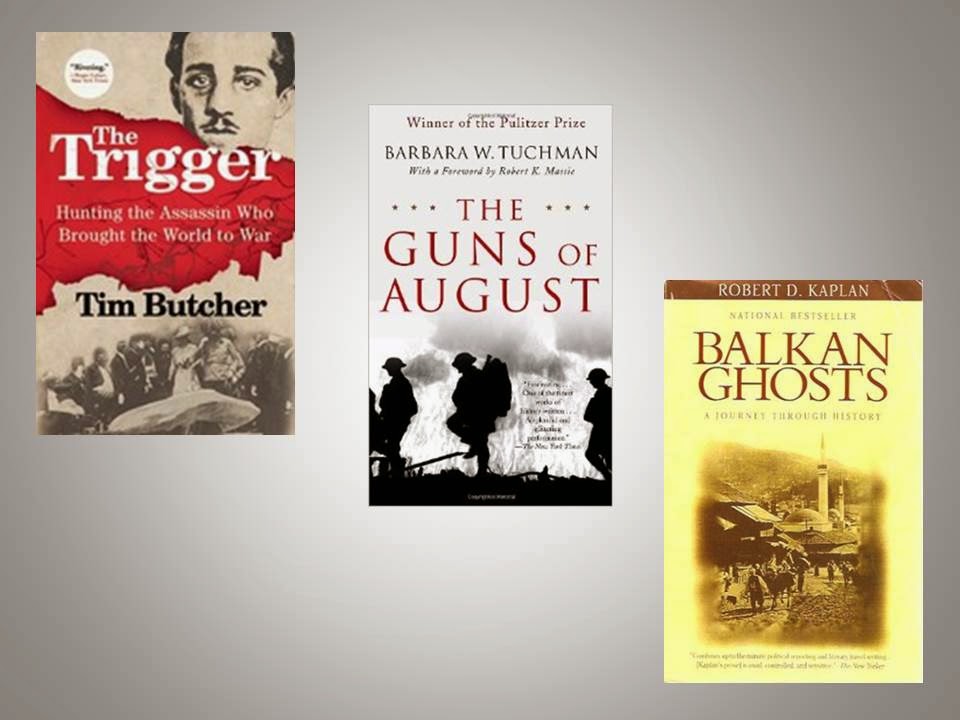
            Journalist Tim Butcher’s new book, The Trigger:  Hunting the Assassin Who Brought the World to War traces the life of Gavril Princip, the nineteen year old who assassinated the Archduke.  I wrote about Butcher’s last book, Blood River, his book following Stanley’s expedition on the Congo River to find Livingstone in an earlier blog. The Trigger  follows a similar template.  Butcher travels to rural Bosnia to begin the story of Princip, a boy from a poor subsistence farming family  whose descendants still live in the tiny village, much as they have for generations and follows his path from there to Sarajevo, then Belgrade, then back to Sarajevo for the fateful act.  Butcher is a great storyteller and a consummate old-school journalist, and it comes through in his work.  First, he immerses himself in research and then he talks to people and faithfully tells their stories.  However, the book is not just about the assassination.  Butcher himself was a war correspondent who covered the Balkans in the 1990s.  He manages to weave the story of the assassination into the intricate fabric of the Balkans, a region shaped by hundreds of years of conflict.  It’s a fascinating read.

Robert Kaplan’s Balkan Ghosts: A Journey Through History is a great book if you’re looking for a more thorough history of the Balkans and the ethnic and religious conflicts that culminated in the wars and genocides of the 1990s.
 
 
 If you’re looking for the classic history of the war, the must-read is Barbara Tuchman’s  The Guns of August.  Tuchman re-creates the first month of the war, and all the steps and machinations leading to the conflict.  This was required reading for a college history course for me, but it was not a chore.  Tuchman is an excellent writer who told an exciting, suspenseful story that happened to be true.
Personally, I’m not a huge military history buff, so my interest in war history is mostly interest in causes and effects.  Another classic about the causes of the war is Dreadnought by Robert K. Massie.  Dreadnought is specifically about the naval arms race between Britain and Germany, part of the militaristic fervor that propelled Europe into war, but the book is not a dry naval  history – pun intended.  When I read this book, I learned so much about the European military leaders and royals whose drive to achieve military superiority, in this case by building the greatest battleship, was a major factor leading to the war.
 
           Turning to fiction, I have a couple of recommendations.  All Quiet on the Western Front is one of the greatest war novels ever written.  In fact it is very much an anti-war novel written by German war veteran Erich Maria Remarque.  The reader experiences the build up to the war, the horrors of the war itself, and their effect on the men involved, through the eyes of its protagonist, Paul Baumer and his comrades.   The book was unique for its time, not a jingoistic, super-patriotic glorification of war, but a realistic portrayal.  In fact, it was one of the first books banned in Nazi Germany because of its anti-war message.  It’s one of my favorite classic novels.
            In an earlier blog, I wrote about Ken Follett’s historic epics, The Pillars of the Earth and World Without End about medieval England and the Century Trilogy.  Book One of the Century Trilogy is The Fall of Giants,  and it follows five families (British, German, Russian, and American as they experience the war , the Russian Revolution, and the British women’s suffrage movement.  And when I say epic, I mean epic.  It’s a huge book, but I was thoroughly engaged from the beginning and finished it very quickly.  As one would expect from Follett, it’s full of historical detail, and is an education in itself about the effects of the war on all segments of society.


Friday, August 1, 2014

History, Yum!

By Nina Kendall

                Do you have a taste for history? Are you looking for a good book to sample? Do you want to get someone hooked on history? Try food history.  Food reflects who we are and who we were as a people. It illustrates the influence of technology on society and reveals the cultural traditions and diversity of a region. Food is both an artifact and a motivator. The Columbian exchange transformed the world in part because of the food it introduced to new lands.

            Mark Kurlansky has written several books about history and food.  His works document both the role of food in society and how food reflects change over time. Well researched and accessible, Kurlansky's work is worth checking out.  Salt is an account of food as force of change. Salt made food preservation possible and once served as unit of exchange. This work illustrates how one commodity can influence population, and impact international relations.

In The Food of a Younger Land, Mark Kurlansky uses records from the Federal Writers Project administered by the Works Progress Administration (WPA) to create a picture of food and eating habits in America in the 1940’s. The WPA employed out of work writers to conduct interviews and record traditions during the Great Depression. Mark Kurlansky shares a collection of recipes and stories that describe a land were food is traditional, seasonal, and regional. Kurlansky gives you a glimpse of American food habits before technology and transportation advancements.

The Histocrats are going to use The Food of a Younger Land as inspiration for a hunt for recent history. We have read about the history of drink and Soul Food. We have visited the Coca-Cola Museum Now we are going to hunt for the food of a modern land.  What do we eat now? How have traditions changed? How can we use what we learn to teach students about history?  What would you find if you went hunting in your hometown? Happy eating! May the history you find be delicious.

Friday, July 4, 2014

Georgia in Mind

By Jeff Burns

I’m a proud native Georgian, but like every state, Georgia has many dark episodes in its past.   These blights cannot be ignored or glossed over.  As Maya Angelou wrote, “History, despite its wrenching pain, cannot be unlived, but if faced with courage, need not be lived again.” 

These three books highlight three different aspects of racial injustice in Georgia and the South during the 20th century, and I highly recommend them.
 
Like other southern states, Georgia actively practiced Slavery by Another Name: The Re-Enslavement of Black Americans from the Civil War to World War II (by Douglas Blackmon).  Most people know about the perpetual cycle of sharecropping that kept blacks and poor whites (Many of my white ancestors were sharecroppers.) in bondage to landowners who needed cheap farm labor.  This book investigates the state and corporate sponsored enslavement whereby black men and women, arrested and/or convicted of crimes, petty or major, guilty or not, were forced to do hard labor as their sentence.  This labor force not only did work for county and state governments, but were also “rented” out to landowners and business owners for back-breaking free labor in the private sector.
 
Without Mercy: The Stunning True Story of Race, Crime, and Corruption in the Deep South by David Beasley is the account of the two- term (1936-1940) Georgia Governor E.D. Rivers, the leader of the Georgia Ku Klux Klan, and the pardon racket that he actively ran that allowed white murderers to escape the death penalty and even earn pardons, while the justice system was totally stacked against black defendants.  Beasley tells the stories of a handful of white and black men convicted of murder and their fates.  In the process, he details the massive corruption of Governor Rivers, who made life and death decisions based on race and literally and openly sold pardons to white defendants.
 
University of Georgia history professor Robert Pratt wrote We Shall Not Be Moved: The Desegregation of the University of Georgia, a thoroughly researched history relying on both archived materials and extensive oral histories that begins with the unsuccessful 1950 law school application of Horace Ward and moves on to the integration of Hamilton Earl Holmes and Charlayne Alberta Hunter in 1961.  Even in Georgia, history classes learn about the integration efforts at the Universities of Alabama and Mississippi, but often learn little about the integration of the University of Georgia, perhaps leading people to believe that it was relatively peaceful.  Pratt reveals the fallacy of that inference and exposes the deliberate and organized opposition to their integration.  It’s a fascinating read about a topic that is too often forgotten.

Saturday, June 21, 2014

What so Proudly We Hailed: A Biography

By Nina Kendall

     Summer in the United States is a time of patriotic splendor.  Fireworks, flag displays, and celebrations of important Americans entice people to bask in communal festivities. I treasure memories of the National Fiddle Contest, Flag Day parades, and concerts ending with fireworks.  Summer fun can be extended with a great history book.  This year you can combine your summer celebration with a new book about early America.

     America in the early 19th century was a country of contradictions.  Francis Scott Key led a life that epitomizes those contradictions. Marc Leepson has written a new biography about Key.  In What So Proudly We Hailed, Leepson shares the life of Francis Scott Key who is best known for writing the “The Star Spangled Banner.”  Mr. Key is an American icon whose life is largely unknown. An active citizen, Key was involved in local, regional, and national issues. A lawyer by trade, Key also pursued his interest in religion, public education, and colonization.  

     Leepson makes his research clear in his revelation of the life of Francis Scott Key.  While recounting the events surrounding the writing of the account of the events surrounding the writing of “The Star Spangled Banner”, we learn that Key did not write of the events directly. Leepson’s writing is based on a letter written by Roger B. Taney and the John Skinner’s memories. Both works were written decades after the War of 1812. Key himself only made one public reference to the poem despite delivering numerous public speeches on a variety of topics.

     Key struggles with the issues of the time. He has concerns about how the future of the country will be affected by the resolution of questions surrounding slavery. At times Key defends slaves who sue for their freedom.  Yet, he also works for people who seek the return of slaves. He is troubled by the struggle to create the Missouri Compromise and a huge supporter of the American Colonization Society. Marc Leepson presents these actions to the reader without judgment so that they can draw their own conclusions.

     What So Proudly We Hailed, Francis Scott Key, A Life paints a clear picture of the life of a man who represents the challenges of early America. This is a good book for tying all the pieces of early 19th century America together. Key was a public figure in a period of growth and debate in American history.   Key, the son of a wealthy planter, has well connected relatives and influential friends.  Yet he still strives to be faithful to his religion, improve his community, and influence the future of his country. 

     Connect your summer fun with the enjoyment of early American history. Pick up a book and make a connection with the past.